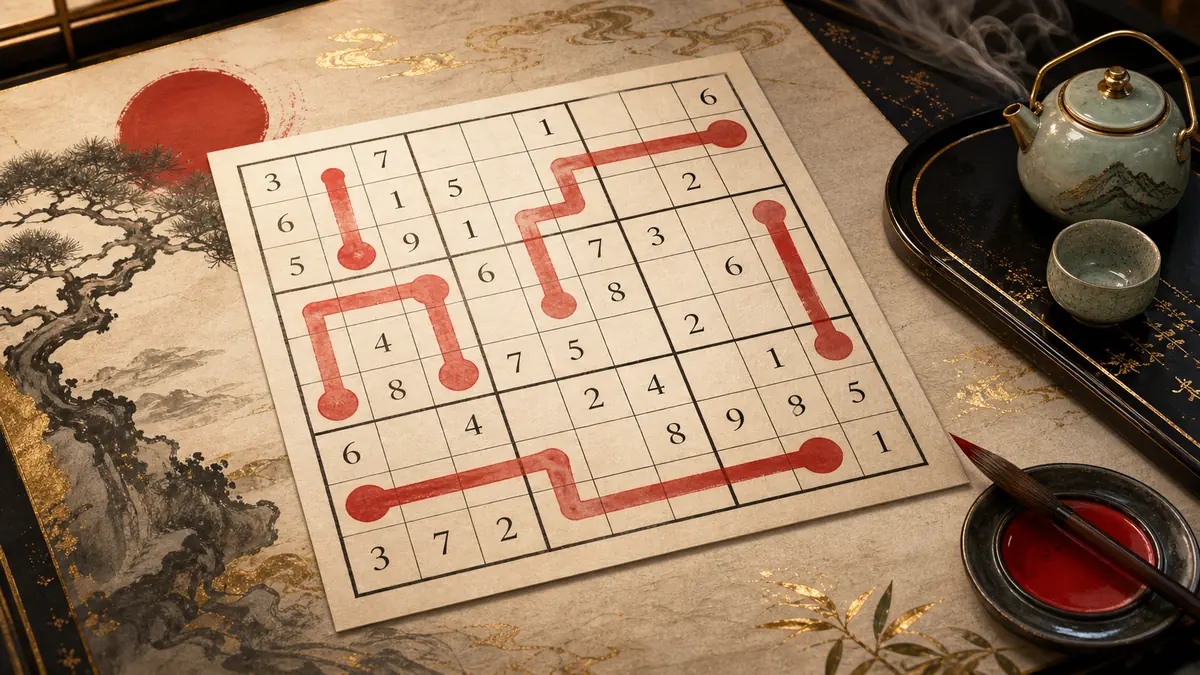
Read ranges before exact numbers
The first Thermo pass should be about low and high possibilities. On a five-cell path, the bulb can only be 1 through 5 because four larger digits must fit after it. The tip can only be 5 through 9 because four smaller digits must fit before it.
That range check is often enough to clean several candidates before a normal Sudoku scan begins. Then the row, column, and box rules can finish the job. A path does not replace Sudoku logic; it gives Sudoku better boundaries.
Bulbs and tips are the pressure points
Bulbs prefer lower digits; tips prefer higher digits. If a bulb sits in a box that already contains 1, 2, and 3, the thermometer becomes tense immediately. If a tip sits in a row that already contains 7, 8, and 9, the top end may collapse just as fast.
Use notes sparingly near the ends of each path. Middle cells usually need more context, but endpoints often tell you what the whole path can no longer be.
| Thermo situation | Quick read | Useful next scan |
|---|---|---|
| Long path | Bulb has a low ceiling; tip has a high floor. | Remove impossible endpoint candidates. |
| Bulb in crowded box | Low digits may already be gone. | Check whether the path must start higher. |
| Tip in crowded row | High digits may already be gone. | Check whether the path can still fit. |
| Two thermos crossing nearby houses | Ranges may squeeze the same row or box. | Scan shared houses before adding full notes. |
How to train Thermo in ZUDOKU
Open Thermo Sudoku and spend the first minute only on paths. Mark the rough endpoint ranges in your head before you chase singles. This prevents the classic mistake: placing a digit that fits Sudoku but breaks the thermometer.
Thermo pairs naturally with Consecutive because both modes care about relative values. Consecutive asks whether neighbors differ by one; Thermo asks whether the whole path rises.
For award practice, choose one behavior: clean path reading, no-hint recovery, or Plus-mode completion. If the timer starts pulling your eyes away from the paths, slow down for one endpoint check and rebuild from there.
Range reading without over-noting
The fastest Thermo improvement is learning what a path cannot contain. A three-cell path can start as high as 7 and end as low as 3. A six-cell path is much tighter: the bulb must be 1 through 4, and the tip must be 6 through 9. These limits are useful even before you know the exact order.
Once you know the rough range, combine it with a normal house. If the bulb's box already contains 1 and 2, a long thermometer in that box may be forced to start at 3 or higher. If the tip's column already contains 8 and 9, the path may need attention from the other end.
| Path length | Bulb cannot exceed | Tip cannot be below |
|---|---|---|
| 2 cells | 8 | 2 |
| 3 cells | 7 | 3 |
| 4 cells | 6 | 4 |
| 5 cells | 5 | 5 |
| 6 cells | 4 | 6 |
When Thermo stalls
Check whether you have been reading only one end of the path. Players often focus on bulbs because low digits feel natural, but tips can be just as strong. A high-end restriction in a row or column may collapse the whole path from the other direction.
If a thermometer crosses a busy box, scan that box after every new placement on the path. The path order and the box rule can squeeze candidates together quickly, especially near the middle cells.
Common endpoint mistakes
The first mistake is putting a comfortable middle digit in the bulb because it fits the row. A 6 may be legal in the row, but it cannot start a five-cell thermometer because there are not enough larger digits left for the path.
The second mistake is ignoring the tip. A tip is not just the last cell in a drawing; it is the high end of the path. If a row or column blocks 8 and 9 from the tip, the entire thermometer may need to be re-read from the top down.
The third mistake is treating the thermometer as separate from Sudoku. A path can say "this cell must be low," but the box may already contain the low digits. The answer comes from both constraints working together.
Use one slow Thermo puzzle to practice endpoint checks. For every path, name the bulb ceiling and the tip floor before you place a digit. That habit will save more time than guessing at the middle.
How to read middle cells
Middle cells are where Thermo gets tempting and dangerous. They are less restricted than endpoints, so a candidate can look comfortable while still forcing an impossible order later. When a middle cell feels likely, test both directions: can smaller digits still fit before it, and can larger digits still fit after it?
This check is especially useful on paths that bend through one box. The bend may share row or box pressure with nearby cells, turning a loose middle candidate into a forced order. If the middle still feels unclear, leave it and solve from the endpoints again.