The rule players forget
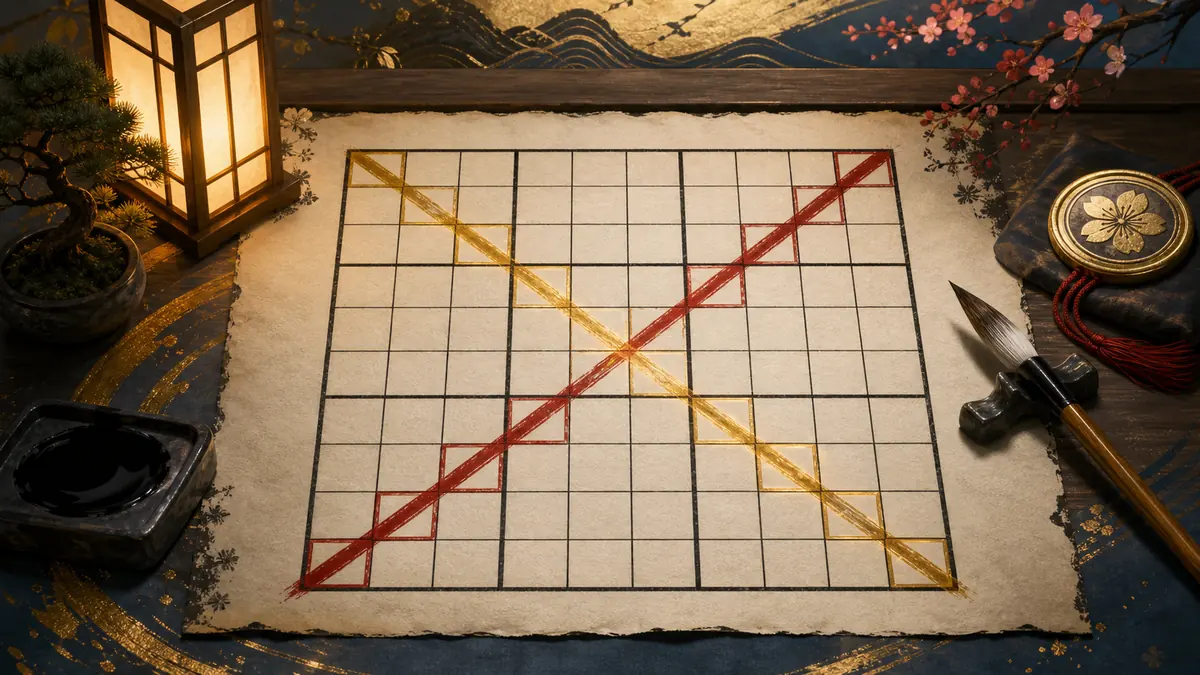
In Standard Sudoku, every cell belongs to three houses: one row, one column, and one 3x3 box. In Sudoku X, some cells get a fourth job. The center cell gets five jobs: row, column, box, main diagonal, and anti-diagonal.
Here is the sort of thing that actually wins a Sudoku X board. If the main diagonal already shows 1, 3, 4, 5, 6, 7, 8, and 9, the missing diagonal cell is 2. Its row may still have several empty places. Its column may look calm. The diagonal is the proof.
When you start a Sudoku X puzzle, trace both diagonals with your eyes before adding notes. It takes a few seconds, and it prevents the most common mistake: treating diagonal cells as ordinary cells until the board stops moving.
A diagonal-first scan
Use this order for the first pass: center, four corners, both diagonals, then the normal rows, columns, and boxes. I like that order because it is awkward enough to interrupt autopilot.
Spend the slowest second on the center. If one diagonal says "not 7" and the other says "maybe 7," the center is where that tension becomes visible. The corners matter because they start the diagonal and often sit in rows or columns that are otherwise easy to ignore.
| Area | What to ask | Why it matters |
|---|---|---|
| Center | Which digits are missing from both diagonals? | One cell controls two diagonal houses. |
| Corners | Do row and column clues restrict the diagonal? | Corners often create early diagonal pressure. |
| Diagonal cells | Is a digit already used on this line? | Diagonal candidates can disappear quietly. |
| Off-diagonal cells | Is this just normal Sudoku? | Do not apply diagonal rules where they do not belong. |
Notes for Sudoku X
When you mark candidates, diagonal cells need one extra cleanup step. After a placement on either diagonal, remove that digit from the rest of the same diagonal. It sounds obvious, but it is easy to forget because the visual grid still emphasizes boxes more than diagonals.
A useful habit is to treat each diagonal like a long thin box. You would not leave a 7 candidate in the same 3x3 box after placing 7. Do not leave it on the same diagonal either. Clean diagonal notes are what make hidden singles show up later.
If you use the solver/checker to review a Sudoku X puzzle, pay attention to whether the missed move came from a row, column, box, or diagonal. That label tells you what to practice next.
Why Sudoku X helps normal Sudoku
Sudoku X trains constraint memory. You have to keep one extra rule active while still doing the familiar work. That makes it a good bridge between Standard Sudoku and heavier variants like Hyper Sudoku, Jigsaw Sudoku, or Killer Sudoku.
It also teaches restraint. Not every cell is diagonal. Some squares are still plain row-column-box work. Good Sudoku X solving means remembering the extra rule without overusing it. That balance is exactly what helps when you return to the standard board above the homepage.
| Problem | What it usually means | Practice response |
|---|---|---|
| You miss diagonal singles | You are scanning boxes before diagonals. | Trace both diagonals before notes. |
| You overuse diagonals | You are applying the rule to off-diagonal cells. | Mark which cells are actually diagonal. |
| Center feels confusing | You are treating it like a normal cell. | Check both diagonals before row and column. |
| Notes get stale | Diagonal cleanup is missing. | After a diagonal placement, clean that line first. |
Training path in ZUDOKU
Warm up with one Standard Sudoku puzzle if your scanning feels rusty. Then play Sudoku X slowly and ignore the timer for the first board. After each placement, ask whether the move changed a row, column, box, diagonal, or several at once.
Once the rule feels natural, add pressure through Daily Dojo or move into PvP. If you are collecting awards, Sudoku X is useful because it trains Plus-mode variety without changing the basic 9x9 shape. That makes it one of the friendlier variants for players who want a new challenge without jumping straight into a huge Samurai grid.
The useful rule of thumb is blunt: before you tap a diagonal cell, check the diagonal. Before you tap a non-diagonal cell, do not invent a diagonal rule. That small distinction is the whole mode.