Read the shapes before the numbers
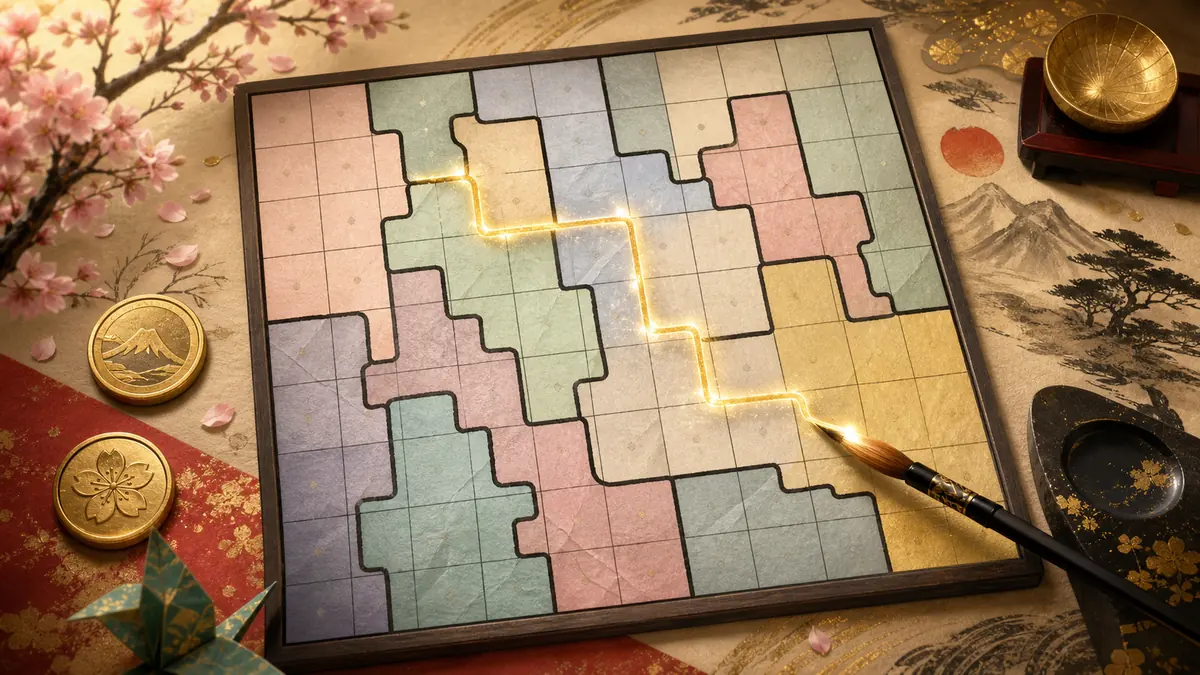
In a Standard grid, your eyes can jump to box corners automatically. In Jigsaw, that habit can betray you. Spend the first half minute naming shapes: long region, bent region, narrow region, crowded region. Then work inside the shapes that already have five or six numbers.
A practical example: if one region stretches across three rows and is missing 1, 4, and 9, do not ask "which square box needs 4?" Ask where 4 can sit inside that exact outline after row and column conflicts are removed. Often the shape does half the work.
Region-row overlap is the money check
The strongest Jigsaw moves usually come from overlap. If every possible 7 in an irregular region sits in the same row, that row cannot use 7 elsewhere. If a row has only one cell inside a region that can take 2, the region and row have agreed on the placement.
This is why Jigsaw is such good practice for scanning. It forces you to name the house you are actually using, instead of leaning on a square that is no longer there.
| Shape clue | Question to ask | Useful follow-up |
|---|---|---|
| Long region | Which rows does it occupy? | Look for one digit trapped in a row segment. |
| Bent region | Where does the bend create a bottleneck? | Check the corner cells after each placement. |
| Thin region | Which columns cover most of it? | Use column conflicts before writing notes. |
| Almost full region | Which two or three digits remain? | Compare those digits against rows first. |
How to train Jigsaw in ZUDOKU
Open Jigsaw Sudoku and play one slow board where every placement must mention the region by shape. "This 8 is in the bent region" is better than "I think 8 fits." That language keeps the rule awake.
After the board, try one normal Standard Sudoku puzzle. Many players notice that their box scanning feels cleaner afterward because Jigsaw forced them to pay attention to actual house boundaries.
For a longer route, use the Jigsaw strategy article, then add one Daily Dojo session. Do not bring Jigsaw into ranked PvP mentally until you can trace the regions without slowing down.
A region-tracing drill
Choose one irregular region and follow its border from cell to cell. Do this before writing notes. The drill sounds basic, but it breaks the strongest bad habit from Standard Sudoku: treating nearby square-ish cells as if they are automatically related.
Once the outline is clear, list the missing digits for that region. If it is missing 3, 5, and 8, scan only those three digits through the rows and columns that cross the region. You are not asking what every empty cell can be. You are asking which of the missing digits is already trapped by the shape.
Now place nothing for ten seconds. Let your eyes compare the region border with the row and column lines. The best Jigsaw moves often come from this overlap: a digit can sit in the region only where one row or one column still allows it.
| Region type | First drill | What it teaches |
|---|---|---|
| Long snake | Count how many rows it crosses. | Row restrictions matter more than box memory. |
| Compact blob | List missing digits before notes. | The region can behave like a dense house. |
| Sharp bend | Inspect the bend cell after each placement. | Turns often become bottlenecks. |
| Split-looking outline | Trace the whole border without lifting your eyes. | Prevents ghost-box mistakes. |
When Jigsaw stalls
Return to the most crowded irregular region, not the most crowded square area. If two digits are missing, compare their legal cells. If three or four digits are missing, use rows and columns to remove candidates before adding more notes.
When a mistake happens, review the border first. In Jigsaw, the error is often not arithmetic or advanced logic. It is simply that the wrong cells were treated as one region.
What good notes look like in Jigsaw
Good Jigsaw notes are shaped by regions. If a digit can only appear in two cells inside the same irregular outline, those two notes matter. If a note was copied into every empty cell because it was technically possible, it may hide the outline you need to see.
Try this rule for one puzzle: only write candidates in the two most crowded regions. After every placement, erase notes that the changed row, column, or region no longer allows. This keeps the board readable and makes Jigsaw feel less like a wall of small numbers.
When you return to the full Jigsaw guide, compare the article drills with this mode page. The goal is the same: see the actual borders, then let rows and columns sharpen the placement.
Best next step after Jigsaw
If Jigsaw starts feeling natural, move to Hyper Sudoku for one puzzle. Hyper keeps square boxes but adds extra regions, so it tests whether you can remember a second house system without losing normal Sudoku discipline. Then return to Jigsaw and notice whether the irregular borders feel easier to trace.
That small rotation is better than grinding one mode until attention goes flat. Jigsaw teaches shape reading; Hyper teaches extra-house awareness; Standard confirms that your fundamentals are still clean.