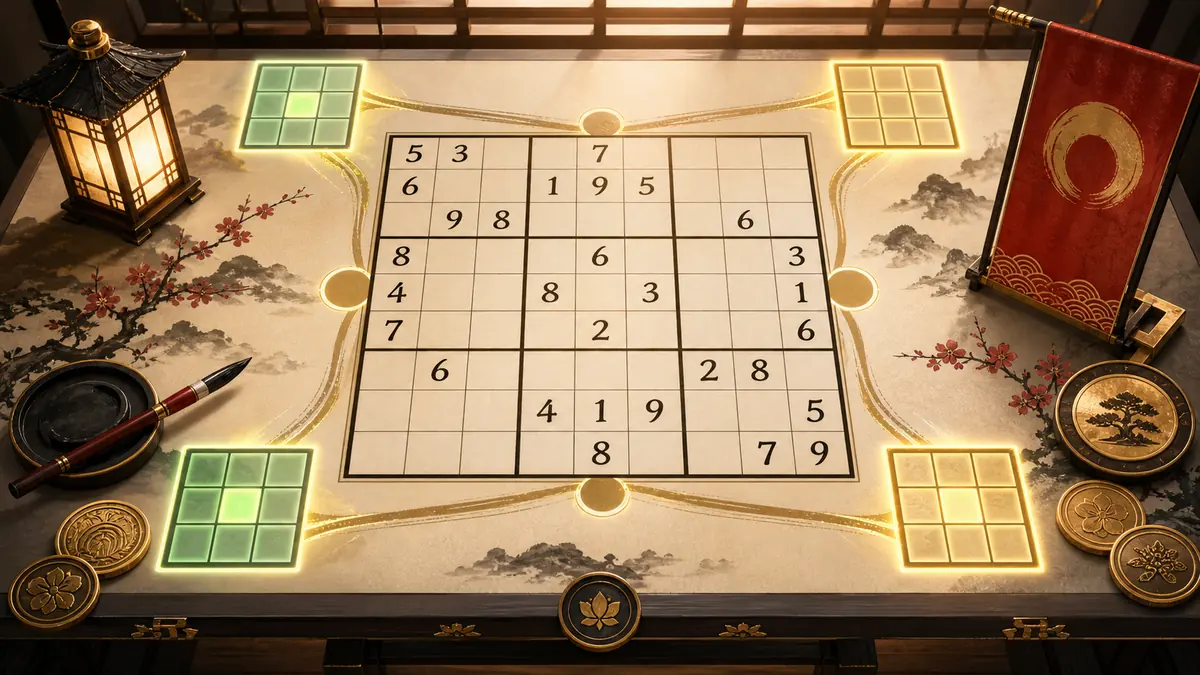
Start with the shaded houses
On a fresh Hyper puzzle, give the four shaded regions one clean pass before the normal digit scan. You are not trying to solve everything at once. You are looking for the shaded region that is already crowded enough to speak.
A useful opening question is: "Which digit is nearly trapped inside this shaded region?" If a region is missing 2, 5, and 8, and two empty cells already see a 5 from their row or column, the remaining empty cell becomes the place to test 5. That small extra house is the whole point of Hyper.
After that, return to the normal Standard Sudoku order: rows, columns, boxes, then digits. The difference is that every shaded cell now has one more witness.
The check that catches most mistakes
Before placing a number in a shaded cell, ask four questions instead of three: row, column, box, hyper region. If the digit survives all four, the move is much safer. If one check feels fuzzy, pause and mark only that region.
Hyper is a Plus mode because those shaded houses change the solve. They are not decoration. They turn ordinary-looking cells into places where one extra rule can remove a candidate.
| Hyper check | Good use | Warning sign |
|---|---|---|
| Shaded region missing list | Write the few digits that region still needs. | You are scanning only rows and columns. |
| Digit inside one region | Place a digit when every other shaded cell is blocked. | The proof works only in the normal box. |
| Overlap with a row | Notice when all possible cells for a digit sit in one row segment. | You remove candidates outside the actual house. |
| Last changed shaded cell | Rescan that region after every placement. | You leave stale notes in the shaded area. |
How to practice Hyper in ZUDOKU
For one training puzzle, ignore the clock and notice every move that used a shaded region. At the end, you should know whether Hyper changed your solve or whether you played it like Standard with tinted squares. That review is more useful than rushing three games.
Once the shaded-region habit feels stable, take it into Daily Dojo or a light timer. For award progress, pair Hyper with the awards guide: one session for clean Plus-mode solves, one for no-hint discipline, and one for speed after the proof is reliable.
Hyper also pairs well with Sudoku X. Both modes add houses without changing the basic grid. If you remember those extra houses under pressure, your Standard Sudoku scan usually becomes sharper too.
A two-minute Hyper opening drill
Before placing your first number, choose one shaded region and name its missing digits. Then pick one digit from that list and ask where it can sit inside the shaded area. Do not scan the entire grid yet. Hyper becomes easier when the first search is small and exact.
Next, move through the other three shaded regions. Look for a region with five or more filled cells, a digit that appears nearby in several rows or columns, or a cell that belongs to both a crowded normal box and a crowded hyper region. Those intersections often do the work.
After the first placement, stay with the shaded region for one more breath. Check whether it now has a naked single, a hidden single, or a digit locked into one row. One Hyper placement often creates the next move in the same shaded house.
| Opening minute | What to do | Stop when |
|---|---|---|
| 0:00-0:30 | Read one shaded region's missing digits. | You can name two likely target digits. |
| 0:30-1:00 | Check row and column blockers for one digit. | Only one or two cells remain plausible. |
| 1:00-1:30 | Repeat on the opposite shaded region. | A second constraint appears. |
| 1:30-2:00 | Return to normal row-column-box scanning. | The extra houses are no longer invisible. |
When Hyper stalls
If no shaded-region move appears, do not assume the puzzle has become advanced. Often the next move is a normal row or box single that refreshes a hyper region afterward. Use the shaded houses as an extra lens, not as the only lens.
A good recovery order is last placement, affected row, affected column, normal box, then shaded region if the cell belongs to one. That keeps you from staring at all four hyper regions when only one of them actually changed.
Three questions before a hint
Before using a hint in Hyper, ask three small questions. Did I check the shaded region touched by the last placement? Did I scan one missing digit inside each shaded region? Did I remove a candidate from a cell that is outside the shaded house?
If those checks find nothing, a hint can be useful feedback. If one of them finds a move, the puzzle just showed you the exact spot your Hyper scan was skipping.