What makes a ZUDOKU solve feel different
Classic Sudoku has one short rule and a lot of consequences: every row, column, and 3x3 box must contain 1 through 9 once. The tricky part is rarely remembering that rule. It is noticing when your eye keeps circling the same comfortable corner while a nearly finished box on the other side is ready to move.
That is why the web board keeps the controls close to the grid. Notes are one tap away, but they do not have to be the first response. Hints are available, but they work best after you have tried to say the next reason out loud: "this row blocks 5 here, this column blocks 8 there, so the last square has to be 2."
Most stuck Standard solves have a small cause. A row was checked but its box was not. A candidate survived because an old note stayed on the board. A player searched for something fancy while a hidden single sat in a crowded house. This page trains that first layer of attention before ZUDOKU adds cages, diagonals, overlaps, or PvP pressure.
A concrete opening check
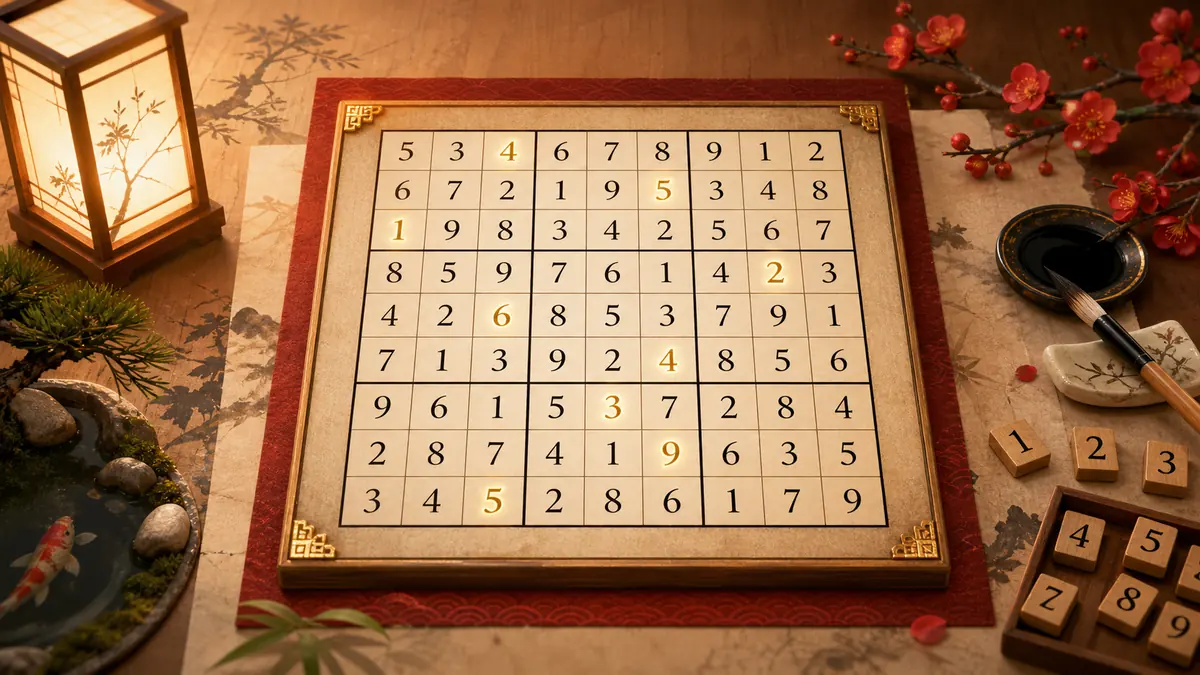
Before you write notes, try one opening pass on the board above. Find a row, column, or box that already has six or seven digits. Choose one missing digit and ask where it can legally go. If every square except one is blocked, you have a hidden single. That is a logical move, not a guess wearing a nice coat.
For example, suppose the top-left box is missing 2, 5, and 8. One empty square is in a row that already has 5 and a column that already has 8. That square must be 2. You did not solve the whole puzzle; you solved one honest sentence: "5 is blocked by the row, 8 is blocked by the column, so 2 remains."
| Opening scan | Question | Good sign |
|---|---|---|
| Almost-full row | Which digits are missing? | One missing digit has only one cell. |
| Almost-full box | Which rows and columns block the missing digits? | A box square becomes forced. |
| Repeated digit scan | Where can this digit fit in each box? | One box has a single legal position. |
| Fresh placement | What changed around it? | The row, column, and box reveal another move. |
Use notes when the board earns them
Notes are useful when they record something you actually checked. They become fog when every empty cell gets every possible candidate because the board looks hard. A good rule of thumb is simple: scan first, place obvious singles, then add notes only in the houses that have stopped moving.
If you use notes in ZUDOKU, clean them after every placement. A stale note is worse than no note because it looks like evidence. Place a digit, scan its row, scan its column, scan its box, then remove candidates that can no longer survive. That small loop makes later pairs and triples much easier to see.
The pencil marks guide goes deeper, but the practical version is enough for most games: write fewer notes, keep them current, and never let notes replace the reason for a move.
How Standard Sudoku connects to the arena
Standard mode is the quiet training room for the rest of ZUDOKU. Killer Sudoku adds cage totals, but it still punishes sloppy row, column, and box checks. Sudoku X adds diagonals, but diagonal logic falls apart if the base grid is messy. Daily Dojo adds a daily scoreboard, and ranked PvP adds another player solving the same puzzle. Both reward the same thing: quick recognition without careless taps.
A useful weekly rhythm is plain. Play one untimed Standard puzzle to warm up. Do one Daily Dojo run when you want pressure. Save PvP for after your eyes feel awake. If you care about long-term goals, open the Awards Vault and choose one behavior for the session: no hints, fewer mistakes, a harder difficulty, or a new mode.
| If your goal is... | Start here | Then try |
|---|---|---|
| Learn rules | How to Play Sudoku | Easy Standard board |
| Stop guessing | No-guess guide | Medium Standard board |
| Improve speed | Scanning guide | Daily Dojo |
| Try variants | Standard warmup | Killer, Sudoku X, or Jigsaw |
When you get stuck
Do not stare at the whole grid. Pick the last placement and inspect the three houses it changed. If nothing appears, choose a digit that already appears five or six times and scan it box by box. If the board still refuses to move, add notes in one constrained area, not everywhere.
That stuck routine also makes the Sudoku Solver more useful. Enter a puzzle when you need to verify a grid or understand why a move is valid, but try one recovery pass first. The solver should explain the missed step, not replace the habit you are trying to build.
Start a new board whenever you are ready. The homepage is deliberately direct: one playable Sudoku grid, clear controls, and enough strategy under the board to make the next solve a little cleaner than the last one.
