Think in pairs, not single cells
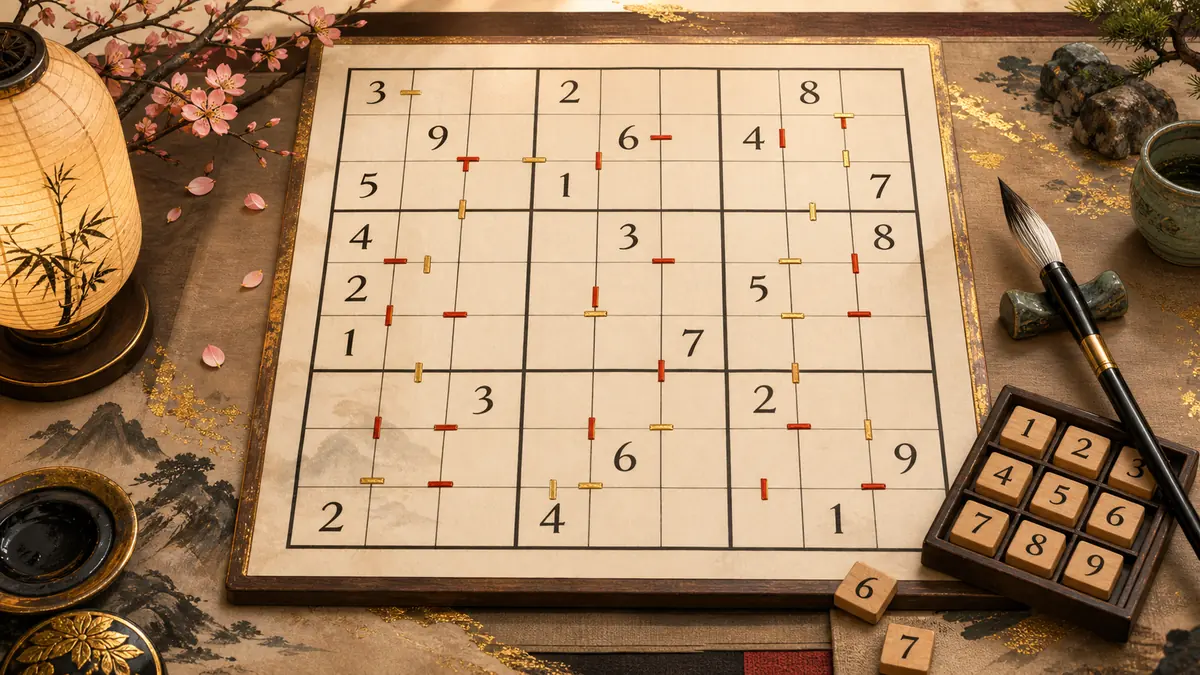
When you see a consecutive mark, read both cells together. If one side cannot be 1, 5, or 9 because of row and box conflicts, the other side loses the matching partners too. A tiny mark can remove candidates from both cells at once.
Example: if a marked pair sits in a row where 4 and 8 are already used, then 3-4, 4-5, 7-8, and 8-9 are gone for that edge. The remaining pair list may become short enough to combine with an ordinary row or box scan.
Chains are stronger than lone marks
A chain of consecutive marks is where the mode becomes interesting. The middle cell in a three-cell chain must work with both neighbors, so it cannot be treated like an ordinary empty cell. If the middle value is 5, its neighbors must be 4 or 6. If the middle value is 1 or 9, one side immediately becomes impossible in a two-neighbor chain.
Use targeted notes on chains first. Filling the whole board with candidates before reading the marks usually makes the important pairs harder to see.
| Consecutive clue | First read | Best next action |
|---|---|---|
| Single marked edge | List allowed digit pairs. | Remove pairs blocked by row, column, or box. |
| Two-edge chain | Check the middle cell first. | Reject middle values with no two neighbors. |
| Mark near a full house | Use the missing digits list. | Keep only pairs that include available digits. |
| Unmarked area | Use normal Sudoku rules. | Do not invent a consecutive relationship. |
How to train Consecutive in ZUDOKU
Play one Consecutive Sudoku board with a pair list beside the first three marks you inspect. You do not need to write every candidate. You need to learn which pairs disappear fastest.
Then play a normal Killer Sudoku or Thermo puzzle. Killer links cells by sum; Thermo links cells by order; Consecutive links cells by neighbor value. Rotating these modes makes constraint reading feel less mechanical.
If you are chasing awards, make the session goal specific: one clean pair-chain solve, one no-hint recovery, or one Plus-mode completion. Broad goals make this mode noisy; narrow goals make it teachable.
The pair list that saves time
A single consecutive mark can start with this short list: 1-2, 2-3, 3-4, 4-5, 5-6, 6-7, 7-8, 8-9. The list becomes powerful only after Sudoku removes options. A row that already has 2 and 7 removes every pair containing those digits from that row's marked edge.
Do not memorize a giant chart. Train the motion: list pairs, remove blocked digits, then check whether one side of the mark has fewer options than the other. The weaker side of the pair is usually where the proof begins.
| Digit in one cell | Possible neighbor digits | Useful note |
|---|---|---|
| 1 | 2 only | Edges are restrictive. |
| 2 | 1 or 3 | Low pairs stay narrow. |
| 5 | 4 or 6 | Middle digits need both sides checked. |
| 8 | 7 or 9 | High pairs mirror low pairs. |
| 9 | 8 only | Edges are restrictive again. |
When Consecutive stalls
Look for a mark touching a nearly finished row, column, or box. If a house is missing 3, 4, and 9, a consecutive edge inside that house probably cannot use 9 unless it can pair with 8 from the other cell. That is the kind of interaction that opens the board.
If the marks are quiet, switch back to ordinary Sudoku for one pass. Consecutive clues are constraints, not the whole puzzle. A normal single can make the next marked pair obvious.
Positive marks and ordinary edges
In ZUDOKU, read the visible consecutive marks as positive information: the two neighboring cells on that edge must be consecutive. Do not invent a relationship on every unmarked edge while solving. If an edge has no mark, let normal Sudoku rules handle it unless the puzzle UI gives a separate rule saying otherwise.
This distinction keeps the mode clean. A marked 4-5 pair can be powerful, but an unmarked pair should not become a fake clue in your head. Many mistakes in Consecutive Sudoku come from over-reading the board.
A good practice session is one row at a time. Pick a row with a mark, list the row's missing digits, then check which of those digits can form a consecutive pair. After that, return to columns and boxes. The pair clue and the classic Sudoku houses should take turns, not compete.
If you like award goals, Consecutive is a good mode for accuracy awards. Every marked edge gives you a chance to prove a small relationship before you place anything.
Best first row to inspect
Start with a row or column that has both a consecutive mark and several filled digits. Empty rows with marks are interesting later, but they do not remove enough pairs at the start. A nearly finished row can turn a mark into a very short pair list.
If the row is missing 1, 2, 6, and 9, a marked edge inside that row already has obvious pressure. The 1 can only pair with 2, and the 9 can only pair with 8, which may not even be available in that row. That is the kind of early clue worth chasing.