What the 500-award system is
The ZUDOKU awards system is a long-term progression layer built around how people actually play: learning the rules, finishing puzzles, solving cleanly, getting faster, keeping streaks, trying modes, competing, and coming back tomorrow.
The important thing is that the award is not the puzzle. The puzzle is still the work. The award is the receipt: you finished a board cleanly, kept a streak, explored a Plus mode, solved without a hint, or stayed calm in a ranked match.
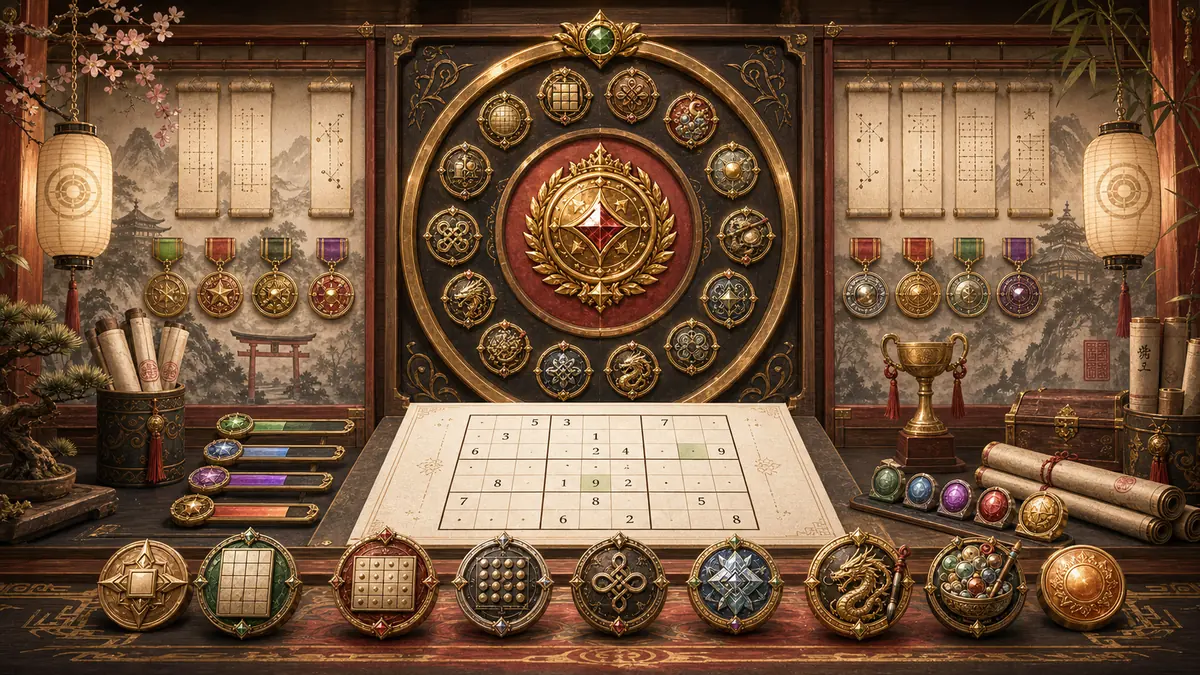
Do not open the Awards Vault and try to memorize 500 targets. That is noise. Open it like a map: earned awards show what already fits your style, locked awards suggest possible routes, and rarity filters separate quick wins from long projects.
| Award family | What it encourages | Best habit |
|---|---|---|
| Starter awards | Learning the interface and rules | Finish early puzzles calmly |
| Clean-solve awards | Accuracy and proof | Explain moves before tapping |
| Speed awards | Recognition and routine | Scan in a fixed order |
| Hintless awards | Self-reliance | Run a recovery routine before hints |
| Mode awards | Variant flexibility | Rotate Standard, Killer, and Plus modes |
| Daily awards | Consistency | Play one focused Daily Dojo session |
| PvP awards | Pressure control | Warm up before ranked games |
| Collection awards | Long-term motivation | Review progress weekly |
A first-week award route
A new ZUDOKU player does not need an ambitious collection plan. The first week should prove that the game can become a calm habit. Start with Standard Sudoku, add one Daily Dojo run, then try one variant only after the basic scan feels steady.
A simple seven-day route works well: two Standard solves for comfort, one no-guess attempt, one Daily Dojo session, one Killer or Jigsaw exploration, one clean-solve attempt, and one review day where you look at earned and locked awards. That is enough variety to wake up the collection without turning every board into a spreadsheet.
| Day | Session | Award signal to watch |
|---|---|---|
| 1 | Finish one Standard puzzle slowly | Starter completion |
| 2 | Replay Standard with cleaner notes | Accuracy and note discipline |
| 3 | Try one solve without guessing | Proof before placement |
| 4 | Play Daily Dojo once | Consistency and daily rhythm |
| 5 | Try Killer, Jigsaw, or Thermo | Mode exploration |
| 6 | Attempt one clean solve | Mistake control |
| 7 | Review earned and locked awards | Choose next week's focus |
Why awards help the habit last
Sudoku improvement is slow in the best way. You rarely become stronger from one puzzle. You become stronger because dozens of small habits become automatic. Awards make those habits visible.
This matters because players often judge improvement only by finish time. Time is useful, but it is not the whole story. A ten-minute clean solve can be a better training session than a seven-minute solve full of lucky guesses. Awards create more ways to recognize good play.
They also create choice. Some days you may want Daily Dojo pressure. Other days you may want a calm Standard puzzle or a Killer Sudoku cage session. The award system gives each kind of session a purpose without forcing every session to feel the same.
Beginner award path
New players should start with completion and comfort. The first goal is not to master every technique. It is to understand rows, columns, boxes, notes, and simple singles. Early awards should feel like a welcome mat, not a test.
A strong beginner path is simple: finish Standard puzzles, use notes intentionally, avoid random guesses, and learn why mistakes happen. The awards that come from this phase are valuable because they build trust in the board.
If a beginner wants to chase too many awards immediately, the puzzle can become secondary. Keep the first stage narrow: finish boards, reduce mistakes, and learn one new solving habit at a time.
| Beginner goal | Award behavior | Internal guide |
|---|---|---|
| Learn rules | Finish first Standard boards | How to Play Sudoku |
| Find singles | Place forced moves | Singles guide |
| Use notes | Track candidates cleanly | Pencil Marks |
| Avoid guesses | Prove placements | No-guess solving |
Intermediate award path
Intermediate players usually need better candidate discipline. This is where awards tied to clean solves, hintless solves, note use, difficulty progress, and variant exploration become more meaningful.
The best intermediate strategy is to pick one award family per week. One week can focus on hintless Standard solves. Another can focus on Killer Sudoku. Another can focus on Daily Dojo streaks. This keeps progress interesting without turning every puzzle into a checklist.
Intermediate players should also review failed award attempts. If a clean solve failed because of one wrong candidate, the real lesson is note cleanup. If a speed attempt failed because of a guess, the lesson is opening routine.
| Weekly focus | What to play | What to measure |
|---|---|---|
| Clean solves | Standard or Sudoku X | Mistakes per puzzle |
| Hintless solves | Medium Standard | Recovery routine before hints |
| Mode variety | Killer, Thermo, Jigsaw | Extra rule remembered before placement |
| Daily consistency | Daily Dojo | First-stall time and finish quality |
How to prioritize award families
Five hundred awards is intentionally too many to hold in your head during one solve. That is part of the design. The collection should feel wide enough for careful beginners, speed-focused solvers, Daily Dojo regulars, variant fans, and ranked competitors. The practical move is to group awards by behavior, then pick the behavior that matches the session you want.
If you are tired, choose a low-friction family: completion, streak, or Standard practice. If you are sharp, choose a harder family: hintless, speed, higher difficulty, PvP, or a variant that forces extra constraints. If you have been playing only one mode, choose a mode family so the collection nudges you into different thinking.
This keeps the award system healthy. Do not ask every puzzle to do every job. One puzzle can be about accuracy. The next can be about time. Tomorrow can be about Killer cages or Daily Dojo pressure. Progress becomes steadier because each attempt has a narrow purpose.
A good weekly rhythm is one comfort session, two skill sessions, one variant session, one Daily Dojo focus, and one optional ranked session. Leave one empty day if you can. Rest is not lost progress; tired solving teaches bad habits quickly.
| Player state | Best award family | Why it fits | Watch out for |
|---|---|---|---|
| New or rusty | Completion and beginner milestones | Builds comfort with the interface and rules | Chasing speed too early |
| Accurate but slow | Scanning and speed milestones | Rewards better order of attention | Replacing proof with panic |
| Fast but messy | Clean solve and hintless milestones | Forces proof before placement | Ignoring stale notes |
| Variant curious | Mode milestones | Trains different rule systems | Switching modes before learning one |
| Competitive | PvP and Daily Dojo milestones | Tests habits under pressure | Starting ranked without a warmup |
Session templates for award hunting
An award session should be small enough to finish with attention. Long sessions can be fun, but they are also where sloppy moves creep in. If the goal is collection progress, set the frame before the first puzzle: mode, award family, time limit, and review question.
The shortest useful session is one puzzle plus one note. The note can be embarrassingly plain: "I missed a hidden single in column seven" or "I used a hint before checking the changed box." That sentence turns the award attempt into training even when the award does not trigger.
For a deeper session, use three puzzles. Puzzle one warms up your eyes. Puzzle two is the award attempt. Puzzle three is the correction puzzle, where you replay the habit that just failed or succeeded. I use this shape for clean-solve attempts, hintless practice, and ranked preparation because it leaves room to learn instead of only chase.
For Daily Dojo, keep the template even tighter. Warm up with a small Standard puzzle, play the Daily Dojo once with full attention, then do a thirty-second review. Daily competition can become noisy if you play five rushed boards around it. One careful run is usually better for awards and skill.
| Template | Length | Use it for | Exact routine |
|---|---|---|---|
| One-and-review | 8-15 minutes | Completion, clean solves, easy streaks | Play one puzzle, write one lesson |
| Warmup plus target | 15-25 minutes | Speed, hintless, Daily Dojo | Warmup slowly, then attempt the award |
| Three-puzzle ladder | 25-45 minutes | Intermediate technique awards | Warmup, target, correction puzzle |
| Mode block | 30 minutes | Killer, Thermo, Jigsaw, Hyper, Samurai | Play the same mode until the extra rule feels natural |
| PvP prep | 20 minutes before ranked | Ranked progress and pressure control | Standard warmup, one Daily Dojo-style solve, then ranked |
Reading rarity and locked awards
The Awards Vault separates earned and locked awards, and it also gives rarity filters such as common, uncommon, rare, epic, legendary, and mythic. Use those filters as a planning tool. Common awards are usually good session starters. Rare and epic awards are better treated as projects. Legendary and mythic awards should feel like long-term markers, not daily obligations.
When the vault feels overwhelming, filter down instead of scrolling forever. Look at one rarity, one mode, or one behavior family. A locked Jigsaw award, for example, should become a concrete session plan: trace regions, finish cleanly, review one mistake. That is much easier to act on than "collect more awards."
Locked awards can be motivating, but they can also pull attention away from the next clean move. When a locked award looks interesting, translate it into a practice behavior. Do not think "I need that badge." Think "I need three clean Killer solves," "I need a stronger no-hint routine," or "I need to keep a Daily Dojo streak alive this week."
Earned awards are useful too. They show which behaviors already fit your style. If most of your earned awards are Standard completion awards, your next growth may be variants. If most are speed awards, accuracy may be the missing layer. If Daily Dojo awards are strong but PvP awards are quiet, pressure against another player might be the next test.
| Filter | What to do with it | Good question |
|---|---|---|
| Earned | Review strengths | Which habits already show up often? |
| Locked | Choose one realistic target | What behavior would unlock progress? |
| Common | Use as warmups | Can I collect this without rushing? |
| Rare or epic | Build a weekly plan | What practice block supports it? |
| Legendary or mythic | Treat as long-term goals | What smaller awards are on the path? |
Using ZOKU progress well
The Awards Vault also frames progress through ZOKU. Treat that number as a broad signal, not as the only scoreboard that matters. A growing total means you are showing up across the arena, but the type of progress matters just as much as the amount. Ten careful awards in areas that used to be weak can mean more than twenty easy repeats in a comfort zone.
A useful ZOKU check is to ask what the progress came from. Did it come from Standard consistency, Daily Dojo streaks, mode variety, PvP pressure, or harder logic? The answer tells you which part of your Sudoku identity is growing. If the answer has been the same for weeks, it may be time to rotate.
Do not compare your ZOKU path too harshly with another player. Some solvers collect quickly because they play many short puzzles. Others build slowly because they prefer harder boards or long Samurai sessions. Both paths are valid if the player is actually improving. The award system is strongest when it gives you a personal map, not a reason to resent someone else's route.
| ZOKU signal | What it might mean | Smart next step |
|---|---|---|
| Progress mostly from Standard | Core fundamentals are active | Add one variant block this week |
| Progress mostly from Daily Dojo | Consistency is strong | Review one solve for technique quality |
| Progress mostly from speed | Recognition is improving | Add a clean-solve session to protect accuracy |
| Progress mostly from variants | Adaptability is growing | Return to Standard and notice faster scanning |
| Progress has slowed | You may be repeating safe goals | Pick one locked award family as a project |
Recovering after a failed award attempt
Failed award attempts are not wasted if you review them honestly. A missed speed target can reveal a slow opening scan. A broken hintless attempt can reveal that you do not have a good recovery routine. A lost PvP game can show that you started tapping before the board was stable.
The important thing is to separate the award result from the learning result. You may fail the badge and still improve the habit. You may earn the badge and still make a choice you should not repeat. The best players do not treat awards as a judge of personal worth. They treat them as feedback from the arena.
Use a three-question review. First: what was the first moment I lost clarity? Second: what rule, house, or candidate relationship should I have checked? Third: what will I do differently in the next puzzle? This takes less than a minute, and it protects the next session from becoming a repeat of the same mistake.
If frustration is high, choose a softer next puzzle. Return to Standard, lower the difficulty, or play a familiar mode. A calm correction puzzle is more useful than forcing another difficult attempt while annoyed. Awards are a long collection; one failed run does not matter unless you ignore the lesson.
| Failure signal | Likely cause | Correction puzzle | Next award angle |
|---|---|---|---|
| One wrong placement | Skipped proof | Slow Standard solve | Clean solve |
| Needed a hint too early | No recovery routine | Medium puzzle with full notes | Hintless progress |
| Timer collapsed | Unclear scan order | Easy puzzle with fixed scan passes | Speed with accuracy |
| Variant rule forgotten | Mode switching too fast | Three puzzles in the same mode | Mode mastery |
| PvP pressure mistake | No warmup or reset | Daily Dojo-style practice | Ranked consistency |
Advanced and competitive award path
Advanced players should use awards to sharpen weak spots. If speed is strong but accuracy is fragile, clean-solve awards matter. If Standard feels automatic, mode awards force new constraints. If practice feels isolated, ranked PvP awards test whether logic survives pressure.
Competitive awards should be treated carefully. PvP rewards speed, but awards should not push you into reckless moves. The best ranked progress comes from a warmup, a stable opening scan, and a willingness to abandon a risky guess before it poisons the board.
Advanced award hunting is also about recovery. A strong player can lose a streak, miss a clean solve, or fail a ranked target and still extract a useful lesson. The collection grows faster when every failed attempt improves the next run.
Daily Dojo and streak awards
Daily Dojo awards are powerful because they attach progress to a calendar. A daily puzzle lowers the friction of practice: you do not need to choose what to play; you need to show up and solve well.
The danger is autopilot. A streak is useful only if the session remains intentional. Before opening Daily Dojo, choose one focus: clean notes, no guessing, speed, or first-stall time. After the solve, name one thing that improved and one thing to watch tomorrow.
This small review keeps streak awards from becoming empty attendance. You are not only preserving a number; you are building a ritual that makes the next puzzle easier to read.
| Daily focus | Question after the solve | Award value |
|---|---|---|
| Accuracy | Where did the first mistake almost happen? | Clean-solve progress |
| Speed | Which scan saved time? | Timer progress |
| No hints | What did I do before asking for help? | Hintless progress |
| Consistency | Did I show up with attention? | Streak progress |
Mode mastery awards
ZUDOKU modes make the award system broader than a single Standard Sudoku ladder. Standard builds fundamentals. Killer Sudoku adds arithmetic cages. Thermo adds order. Sudoku X adds diagonals. Jigsaw changes regions. Hyper adds extra houses. Consecutive adds neighbor relationships. Samurai tests multi-grid patience.
Mode awards are useful because they prevent one-skill comfort. If a player only solves Standard, they may become fast at familiar patterns but weaker at adapting. Variant awards encourage flexibility.
The smart approach is rotation. Do not jump from one unfamiliar mode to another every few minutes. Give each mode a short block of practice, then return to Standard and notice what changed in your thinking.
| Mode | Skill trained | Award mindset |
|---|---|---|
| Standard | Core scanning | Baseline consistency |
| Killer | Sums and cages | Constraint stacking |
| Thermo | Order and ranges | Candidate filtering |
| Sudoku X | Diagonal houses | Rule awareness |
| Jigsaw | Irregular regions | Region tracing |
| Hyper | Extra houses | Overlap awareness |
| Consecutive | Neighbor logic | Pair filtering |
| Samurai | Overlapping grids | Long-form patience |
Award hunting without ruining the puzzle
The worst way to chase awards is to let the award replace the solve. If you are trying for speed, you may guess. If you are trying for hintless, you may stare too long instead of using a reviewable routine. If you are trying for mode variety, you may switch before learning anything.
A better method is to define a session contract. One puzzle, one award family, one review. If the award happens, good. If it does not happen, the review still makes the session useful.
This keeps ZUDOKU from becoming a checklist simulator. The puzzle stays central, and the award becomes a signal that a real habit is improving.
| Bad award chase | Better contract | Why it works |
|---|---|---|
| Speed at any cost | Fast but no guessing | Protects accuracy |
| Hintless stubbornness | One recovery routine before hint | Turns hints into feedback |
| Mode hopping | Three puzzles in one mode | Builds real familiarity |
| Collection obsession | Weekly award focus | Keeps progress readable |
A practical award planner
Use a simple planner if you want to collect awards steadily. Pick one short-term award, one weekly award, and one long-term award. The short-term award gives today a purpose. The weekly award creates rhythm. The long-term award keeps the collection moving.
For example, today can be a clean Standard solve. This week can be a Daily Dojo streak. This month can be Killer Sudoku mode progress. That stack is ambitious enough to stay interesting but not so broad that every puzzle feels overloaded.
Review the planner once per week. If you are avoiding one award family, that is probably where your next growth is hiding.
| Planner slot | Example | Review question |
|---|---|---|
| Today | Clean solve | What almost caused a mistake? |
| This week | Daily Dojo streak | Did the routine stay focused? |
| This month | Killer mode progress | Which cage logic improved? |
| Long-term | Collection depth | Which award family is neglected? |
Useful references
For general Sudoku background, see Wikipedia on Sudoku and Britannica. For broader puzzle culture, the World Puzzle Federation gives useful context for puzzle competition and long-term skill development.
FAQ
How many awards are in ZUDOKU?
ZUDOKU has 500 awards across learning, completion, accuracy, speed, Daily Dojo, PvP, mode exploration, and long-term collection.
What is the best first award path?
Start boring on purpose: finish Standard puzzles, find singles cleanly, and reduce mistakes. Those habits make every flashier award easier later.
Should I chase speed awards early?
Only after accuracy is stable. Speed awards are fun, but a fast wrong tap teaches the wrong lesson.
How do Daily Dojo awards help?
They turn practice into a daily ritual. The useful part is not only the streak; it is the tiny review after the solve: what worked today, and what almost broke?
Do awards work with every mode?
Yes. Mode awards matter because each variant trains a different kind of attention: cages, regions, diagonals, thermometers, overlaps, or pressure.