Why this matters
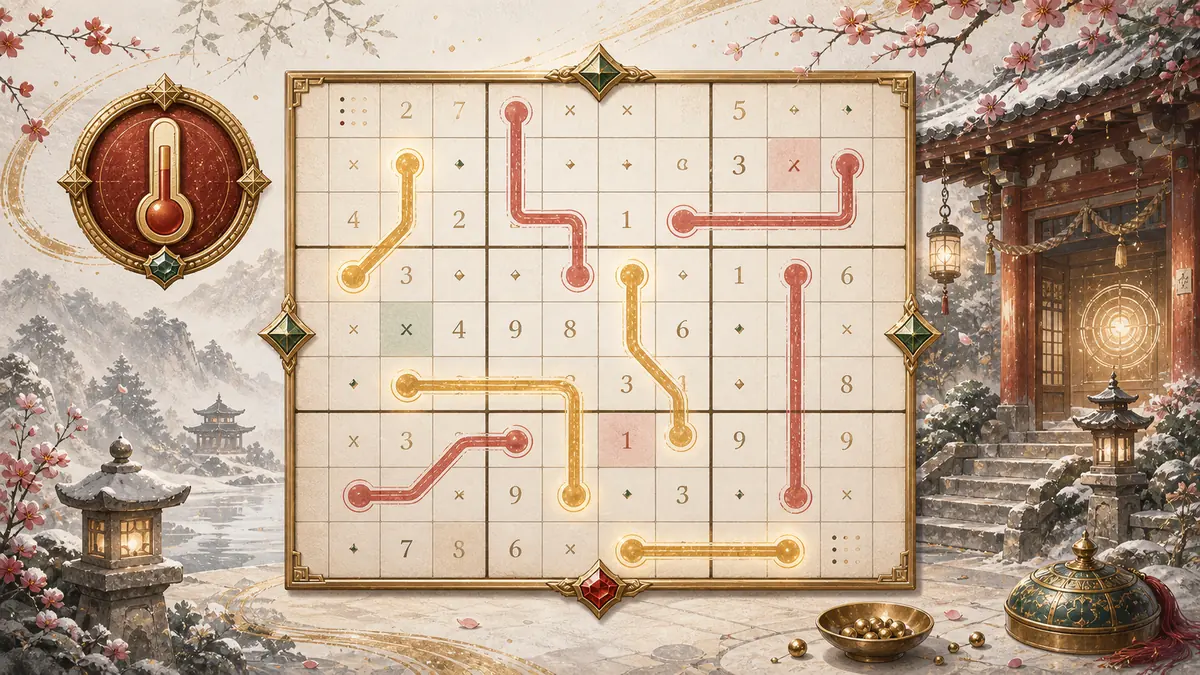
Thermo changes the first look at the grid. In Standard Sudoku, an empty cell may be wide open until rows, columns, and boxes speak. On a thermometer, the path already has an opinion: a six-cell thermo cannot start with 6, 7, 8, or 9 because there are not enough larger digits left to climb.
That early range pressure is easy to waste. Many players stare at the middle of the path, where almost everything feels possible, while the bulb and tip are quietly doing the useful work. Read the ends first, then let normal Sudoku finish the argument.
Open a Thermo board while reading this and choose one path. Name the highest possible bulb and the lowest possible tip before you write any notes.
Core idea
The shortest version is this: every cell on a thermometer has a floor and a ceiling. On a four-cell path, the bulb can be at most 6 and the tip can be at least 4. Longer paths are tighter. Short paths are looser.
After the rough range is clear, combine it with a normal house. If a bulb's box already contains 1, 2, and 3, that bulb may be forced higher. If a tip's column already contains 8 and 9, the path may need to be read from the other end.
The best Thermo moves usually sound plain: "this bulb cannot be 5 because the path needs four larger digits," or "this tip cannot be 6 because the column already owns 7, 8, and 9."
A practical Thermo reading order
Start with path length, then endpoints, then houses. This keeps the solve from turning into random candidate scribbling.
Do not expect every path to give a placement. Often the value is just removing two bad candidates from an endpoint. That is still progress.
| Step | Action | What to look for |
|---|---|---|
| 1 | Count the cells on the thermometer. | Longer paths have tighter endpoints. |
| 2 | Check the bulb ceiling. | High digits that cannot start the path. |
| 3 | Check the tip floor. | Low digits that cannot finish the path. |
| 4 | Overlay row, column, and box restrictions. | Endpoints squeezed by nearby givens. |
| 5 | Only then look at middle cells. | Values that leave room on both sides. |
Common mistakes
The first mistake is treating a middle cell like an endpoint. A 5 in the middle of a path might look comfortable, but it must still leave enough smaller digits before it and enough larger digits after it.
The second mistake is checking only bulbs. Bulbs are satisfying because low digits are easy to think about, but tips are just as powerful. A blocked high digit at the tip can collapse the whole path from the far end.
| Mistake | Why it hurts | Better habit |
|---|---|---|
| Putting a middle digit in the bulb | The path may not have enough room to rise. | Count how many larger digits must follow. |
| Ignoring the tip | High-end restrictions are missed. | Check the tip floor after every bulb check. |
| Writing full notes too early | Loose middle cells create noise. | Note endpoints before middle cells. |
| Separating Thermo from Sudoku | A path candidate may fail row, column, or box. | Use path order and house rules together. |
Thermo range checker
The length of a thermometer gives a fast endpoint range. These limits are not the whole solve, but they are a clean first filter.
| Path length | Bulb cannot exceed | Tip cannot be below |
|---|---|---|
| 2 cells | 8 | 2 |
| 3 cells | 7 | 3 |
| 4 cells | 6 | 4 |
| 5 cells | 5 | 5 |
| 6 cells | 4 | 6 |
ZUDOKU practice path
Play one Thermo puzzle with no speed goal. For the first few minutes, ignore fancy patterns and write down only endpoint facts: long bulbs are low, long tips are high, and crowded houses tighten both.
Then try the same habit in Daily Dojo or a light timed session. If the timer makes you skip the endpoint check, the puzzle is telling you exactly what to practice next.
For awards, this mode is especially good for clean Plus-mode solves and no-hint discipline. Thermo punishes guesses quickly, so a clean Thermo run is a useful proof habit.
A practical drill for this guide
Choose one Thermo puzzle and inspect only the longest three thermometers before placing anything. For each one, name the bulb ceiling and tip floor. If the path bends through a crowded box, check that box next.
After the solve, remember one path that mattered. Did the bulb get squeezed by low digits? Did the tip get squeezed by high digits? Did a middle cell become forced only after both ends were clear?
| Drill phase | Action | Success signal |
|---|---|---|
| Open | Choose Thermo and ignore the timer. | You are not rushing the endpoints. |
| Count | Mark limits for the longest paths. | Bad endpoint candidates disappear. |
| Combine | Apply row, column, and box pressure. | One path becomes meaningfully tighter. |
| Review | Name the path that opened the board. | The lesson is easy to repeat. |
What to measure while practicing
Measure whether you remembered the Thermo rule early enough. Finish time is secondary while learning. A better metric is how many endpoint candidates you removed before full notation, or whether your first mistake came from forgetting path order.
Keep one short review note: "missed tip floor on row 6" or "long bulb in box 1 was the opener." That is the kind of detail that improves the next puzzle.
| Training goal | Measure | Why it helps |
|---|---|---|
| Accuracy | Mistakes or near-mistakes | Shows whether proof is stable |
| Speed | Time to first strong move | Rewards better opening scans |
| Notes | Stale candidates removed | Keeps the grid readable |
| Variant awareness | Extra-rule checks remembered | Makes Thermo feel natural |
| Pressure | Recoveries before hints or guesses | Builds calm under stress |
How this skill changes under pressure
Under time pressure, players tend to treat Thermo as ordinary Sudoku and remember the paths only after a contradiction. Avoid that by making the endpoint check your first timed habit, not your emergency repair.
Before ranked PvP, use one calm Thermo board as a warmup if path logic has felt rusty. You want "bulb low, tip high" to be automatic before the clock starts pulling at your attention.
| Pressure signal | What to protect | One useful response |
|---|---|---|
| You place from row logic only | Path order | Check the thermometer before tapping. |
| The middle of a path looks tempting | Room on both sides | Count smaller and larger slots. |
| The timer pulls attention | Endpoint routine | Read one bulb and one tip slowly. |
Mistake recovery map
If a Thermo solve goes sideways, return to the path that changed most recently. Subtract the placed value from your mental range, then check whether the next cell on the path now has fewer options.
If that gives nothing, inspect the endpoints of every long thermometer. A missed endpoint is more common than a missed advanced pattern.
| Stuck signal | First pass | Second pass |
|---|---|---|
| A path feels impossible | Recount the path length. | Check whether an endpoint note is stale. |
| No clear placement | Scan long bulbs and tips. | Return to ordinary Sudoku houses. |
| A middle cell looks likely | Test both sides of the path. | Leave it if either side has no room. |
Seven-day practice plan
Use a week if Thermo still feels like Standard Sudoku with lines drawn on top. The goal is to make path order visible before the grid gets busy.
Missed a day? Continue anyway. This is a practice path, not a school attendance sheet.
| Day | Focus | Session |
|---|---|---|
| 1 | Observe | Count endpoints on three long thermometers. |
| 2 | Bulbs | Remove high candidates from long-path bulbs. |
| 3 | Tips | Remove low candidates from long-path tips. |
| 4 | Houses | Combine endpoint ranges with one crowded box. |
| 5 | Middle cells | Test whether both sides of a path have room. |
| 6 | Pressure | Try one timed Thermo board. |
| 7 | Review | Name the path that opened the puzzle. |
Useful references
Thermo Sudoku still sits on the normal Sudoku grid, so the basic rule summary at Wikipedia on Sudoku is useful when you need a neutral reference. For why a 9x9 grid can support many solving paths, see Mathematics of Sudoku. The World Puzzle Federation is also worth knowing if you like puzzle formats beyond ZUDOKU.
FAQ
What is the first thing to check in Thermo Sudoku?
Check path length, then the bulb ceiling and tip floor. Long thermometers restrict endpoints before ordinary Sudoku scanning begins.
Are middle cells important?
Yes, but usually later. Middle cells need enough smaller digits before them and enough larger digits after them, so they are easier to read after the endpoints tighten.
Should I use notes?
Use targeted notes on endpoints first. Full notes are useful later, but early full notation can make the path order harder to see.
What should I read next?
Read Pencil Marks if candidate cleanup is the blocker, or Consecutive Sudoku if you want another relative-value mode.