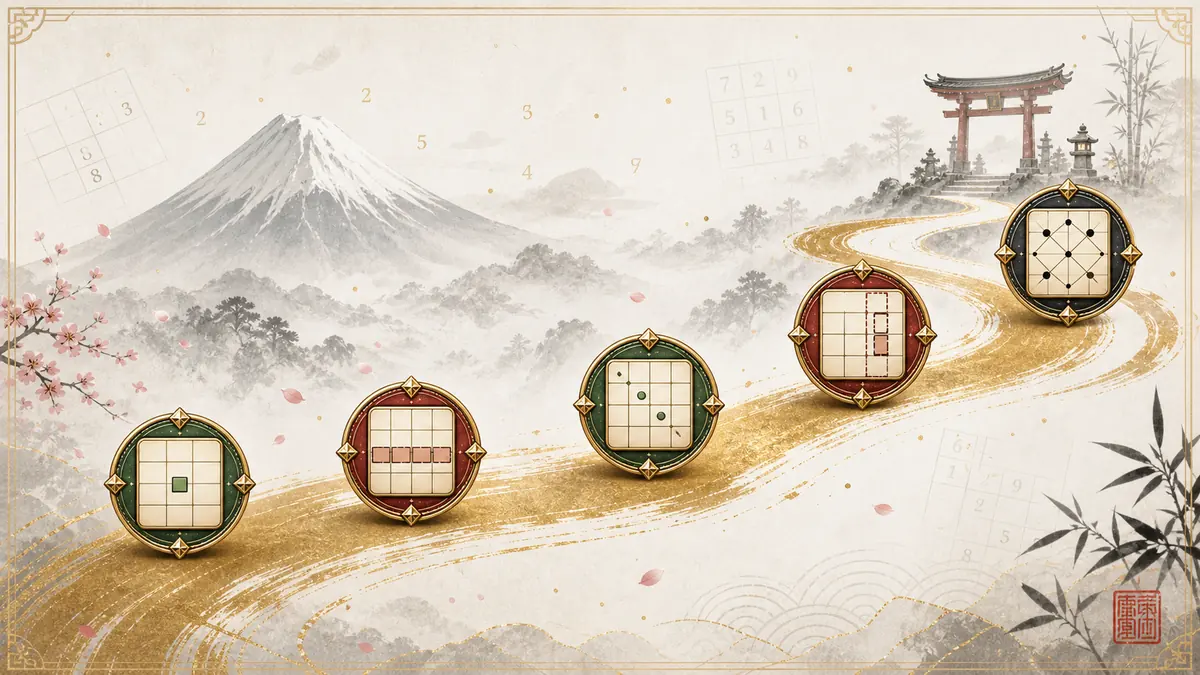
How to use this roadmap
Do not read this like a ladder you must climb in one evening. Use it as a diagnostic. When a puzzle stalls, ask which stage failed first. Did you miss a hidden single? Did an old note hide a pair? Did you start hunting advanced patterns before cleaning the obvious candidates?
The cleanest ZUDOKU test is simple: play one Standard board slowly, then name the first moment where the board stopped being obvious. That pause is more useful than the final time, because it tells you what to practice next.
The roadmap in one view
Sudoku is solved by cycling through constraints: rows, columns, boxes, candidates, and relationships between houses. A full grid looks complicated, but every clean move still comes from one promise: a digit can appear only once in each row, column, and 3x3 box.
Start with moves that remove obvious uncertainty. Then use notation. Then learn how candidate positions interact. This order works for easy puzzles, hard puzzles, Daily Dojo practice, and ranked pressure because it turns the board into a set of small proofs instead of a blur of empty cells.
| Stage | Main technique | What it trains | Practice |
|---|---|---|---|
| Foundation | Rows, columns, boxes | Seeing the three houses that control each cell | Beginner rules |
| Early solve | Naked and hidden singles | Finding forced placements | Singles guide |
| Middle game | Pencil marks | Tracking candidates cleanly | Candidate notes |
| Pressure test | No-guess solving | Choosing provable moves | No guessing |
| Variant growth | Cages and mode rules | Applying extra constraints | Play Killer |
Stage 1: scan before notes
Choose one digit, usually a digit that already appears often, and inspect every row, column, and box where it might fit. If a box has only one legal square for that digit, you have a hidden single. If a cell has only one legal digit after checking its row, column, and box, you have a naked single.
Scanning first protects the board from note overload. On easy and medium puzzles, a calm scan often solves half the puzzle before full notation is useful.
Stage 2: add candidates with purpose
Pencil marks are a way to record what the board has already told you. If one region is almost solved, mark that region first. If one digit has only a few possible homes, mark that digit across several boxes.
Good notes create new singles. Bad notes create visual fog. In ZUDOKU, use notes as a training tool: after every placed number, remove candidates that can no longer survive in the affected row, column, and box.
Stage 3: read candidate relationships
Once notes are clean, a pair of cells may hold the same two digits, locking those digits away from the rest of a row. A digit may appear in only one line inside a box, allowing eliminations along that row or column elsewhere.
Ask one question repeatedly: what is forced if this candidate must live here? That question leads naturally into pairs, triples, pointing candidates, claiming candidates, and more advanced patterns.
Stage 4: practice under pressure
Daily puzzles and ranked games reward speed, but speed comes from recognition rather than panic. A simple loop is enough: scan for singles, update candidates, inspect almost-complete houses, search for pairs, then repeat.
Use Daily Dojo as a structured habit and ranked PvP as a pressure test. Awards on ZUDOKU awards give another reason to practice clean solves, hintless solves, speed bursts, and mode mastery.
A 20-minute training session
A roadmap becomes useful when it turns into a repeatable session. Start with five untimed minutes on a Standard puzzle. Do not rush to fill every note. Pick one digit and ask where it can legally live in each box. When you place a number, immediately rescan the row, column, and box that changed.
Use the next ten minutes for candidate work. Add pencil marks only in regions where scanning has slowed down, then clean those marks after every placement. If a row or box becomes crowded with notes, stop adding more and ask whether a naked single, hidden single, or pair has appeared. Spend the final five minutes on one question: what did I miss first?
| Minute | Focus | Question to ask | Result to expect |
|---|---|---|---|
| 0-5 | Digit scanning | Where can this digit fit? | Hidden singles and easy placements |
| 5-15 | Candidate notes | Which candidates survived all three houses? | Cleaner notes and naked singles |
| 15-18 | Relationships | Do two cells reserve the same pair? | Pair or line eliminations |
| 18-20 | Review | Which step actually unlocked the board? | A clearer next practice target |
How to know you are ready
Do not move to advanced patterns because a puzzle feels hard. Move because your current stage is genuinely exhausted. If you still miss hidden singles, advanced pattern study will feel noisy. If your notes are stale, pairs and triples will produce false conclusions. Readiness is less about puzzle rating and more about reliability.
You are ready for candidate-heavy strategy when you can solve easy boards without guessing, explain your singles, and update notes automatically after placements. You are ready for advanced patterns when your notes are complete, clean, and still no singles or simple pairs remain. That discipline keeps your learning path efficient.
Where ZUDOKU modes fit
Each ZUDOKU mode trains a slightly different kind of attention. Standard Sudoku is the main gym for scanning and candidate discipline. Killer Sudoku adds arithmetic cages, which teaches you to combine placement logic with sums. Sudoku X adds diagonal houses, which is excellent for checking whether you forgot a constraint. Jigsaw changes the region shape, so it breaks the habit of seeing only familiar 3x3 boxes.
Use the modes as a rotation rather than a distraction. If Standard feels too automatic, try Killer to make candidates more meaningful. If you are missing house restrictions, try Sudoku X or Hyper. If you want pressure, use Daily Dojo or PvP after a calm warmup puzzle.
| ZUDOKU path | Skill trained | Best time to use it |
|---|---|---|
| Standard | Core scanning, singles, candidates | Daily baseline practice |
| Killer | Arithmetic constraints and combinations | When notes feel too mechanical |
| Daily Dojo | Consistency and leaderboard pressure | One focused session per day |
| Ranked PvP | Decision-making under time pressure | After a warmup solve |
A seven-day roadmap
One strong week of practice is more useful than a scattered month. Give each day a narrow purpose. If you try to improve scanning, notes, advanced patterns, speed, and variants in the same session, the feedback becomes muddy. When each day has one job, you can tell whether the job is working.
Repeat the week whenever you feel stuck. The goal is not to finish every puzzle perfectly. The goal is to make your solving process visible: what you inspect first, when you start notes, how you recover, and which technique actually creates progress.
| Day | Practice focus | Success signal |
|---|---|---|
| 1 | Rules and no-note scanning | You can explain every placement |
| 2 | Naked and hidden singles | You find singles after each placement |
| 3 | Targeted pencil marks | Your notes reveal new singles |
| 4 | Pairs and locked candidates | You remove candidates without guessing |
| 5 | Killer or Sudoku X variant logic | You remember the extra rule before placing |
| 6 | Daily Dojo pressure | Your routine survives the timer |
| 7 | Review and replay | You can name your weakest stage |
Metrics that matter
Sudoku improvement is easy to misread if you track only finish time. Time matters, especially in competitive play, but a faster solve with three guesses is not the same as a faster clean solve. Track process metrics too: first-stall time, mistakes before notes, hint count, and how often you can explain a placement before making it.
First-stall time is my favorite quiet metric. It marks the moment when simple scanning stops producing moves. As you improve, that moment usually moves later because you find more singles before needing heavier strategy. If it moves earlier, you may be rushing, skipping boxes, or adding notes before reading the board.
Use awards as motivation, not as noise. A clean solve award, a hintless run, or a Daily Dojo streak gives you a reason to practice a specific behavior. The honest answer to "how do I get better at Sudoku" is still small and human: build one reliable habit, then build another on top of it.
Strategy roadmap FAQ
What Sudoku strategy should I learn first?
Learn naked singles and hidden singles first. They are not glamorous, but they teach the habit that matters: every tap should have a reason you can point to.
When should I start using pencil marks?
Start using pencil marks when visual scanning no longer produces reliable moves. If you add notes too early, the grid becomes noisy. If you wait too long, you may hold too much in memory and miss simple candidate relationships.
Are advanced Sudoku techniques necessary?
For some hard puzzles, yes. But they are much easier to learn after the basics are boringly reliable. Dirty notes make advanced patterns look like magic tricks; clean notes make them look like bookkeeping.
How does PvP change the roadmap?
PvP rewards recognition speed, but the underlying roadmap is the same. The difference is that you need a reliable routine before the timer starts to create pressure.
Which ZUDOKU mode is best for improvement?
Standard is the best baseline. Killer, Sudoku X, and other Plus modes are excellent once you want to train extra constraints and make your candidate thinking more flexible.
Final practice note
The roadmap is not meant to make every solve feel formal. Its purpose is to give you a default order when the board stops being obvious. If you always have a next inspection step, you avoid the two habits that slow players down most: staring at the whole grid at once and guessing because movement feels better than uncertainty.
For the next few sessions, choose one stage as the main goal. If you are working on singles, ignore your final time and measure how many placements you can explain. If you are working on notes, measure cleanup accuracy. If you are working on PvP, measure whether your routine survives pressure. Small, focused improvements stack faster than vague effort.
When you return to the same stage later, it should feel easier to recognize. That is the real sign of progress. A technique is not learned when you understand it once; it is learned when you can find it on an unfamiliar board while the clock, the score, or the leaderboard is trying to pull your attention away.
Useful references
For background, see Wikipedia on Sudoku and Britannica. For the math-minded side, see Mathematics of Sudoku. Competition context from the World Puzzle Championship shows how broad logic-puzzle training can become.