The first two minutes matter most
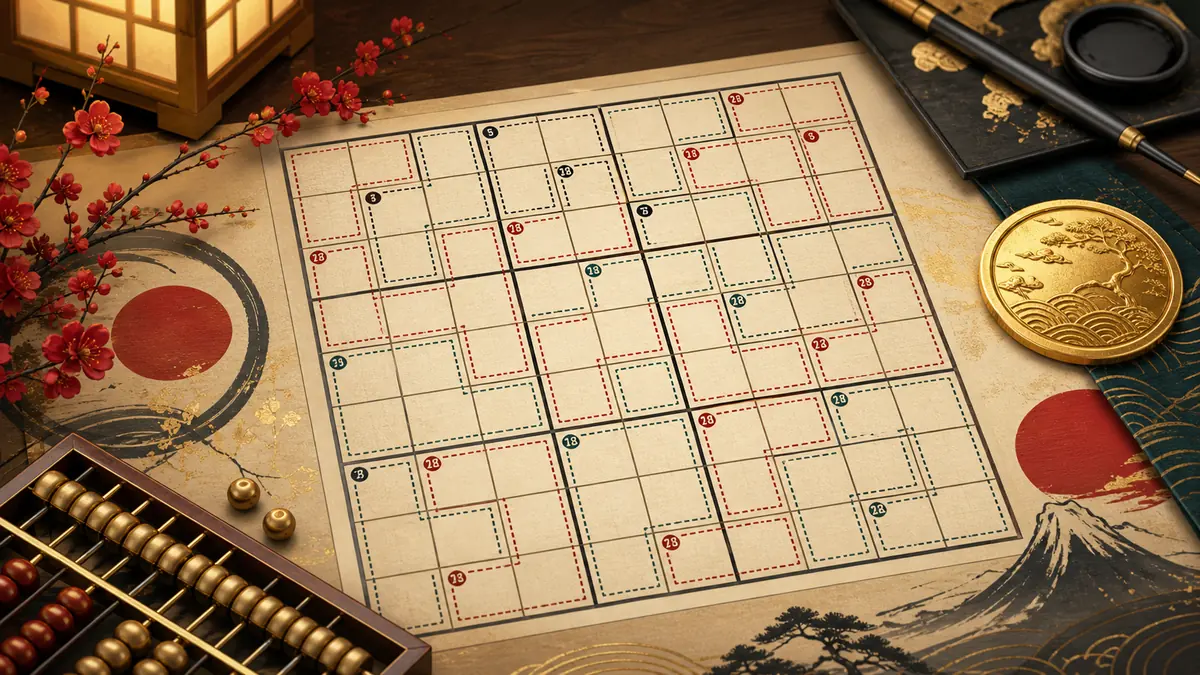
In Killer Sudoku, a rushed opening creates clutter fast. Before filling notes everywhere, look for cages that say something definite: a one-cell cage, a two-cell 3, a two-cell 17, a three-cell 6, a three-cell 24, or a house where cage totals almost add to 45. Those clues are small, but they decide which parts of the board deserve attention.
Here is the kind of move to hunt for first. A two-cell cage marked 3 can only be 1 and 2. If one of those cells sits in a row that already contains 1, that cell must be 2 and the other cell must be 1. It is not a grand technique; it is just the cage and the row agreeing.
High totals behave the same way. A two-cell 17 is 8 and 9. A three-cell 24 is 7, 8, and 9. These cages may not place the digits immediately, but they reserve high numbers and make nearby rows, columns, and boxes less noisy.
Killer rules without the fog
Rows, columns, and 3x3 boxes still use the digits 1 through 9 once. Cages add totals. Digits do not repeat inside a cage. Neither system is secondary. A cage set can add correctly and still fail because a row blocks one digit. A row placement can look legal and still fail because the cage cannot pay for it.
The 45 rule comes from a simple fact: 1 + 2 + 3 + 4 + 5 + 6 + 7 + 8 + 9 = 45. Every full row, column, and box adds to 45. If cages inside a box total 41 and only one cell is outside those cages, that missing cell is 4. Once you notice these little accounting moments, Killer Sudoku becomes much less mysterious.
| Clue | Immediate read | What to do next |
|---|---|---|
| 1-cell cage | The total is the digit. | Place it, then rescan the row and box. |
| 2-cell 3 | Only 1 and 2. | Use nearby 1s and 2s to position the pair. |
| 2-cell 17 | Only 8 and 9. | Block high digits from related houses. |
| 3-cell 6 | Only 1, 2, and 3. | Treat it as a low-digit reserve. |
| Nearly covered house | Use totals toward 45. | Find the missing value or missing sum. |
How to take notes in Killer
Killer notes work best in two layers. First, list the possible sets for the cage. Second, test those sets against the exact cells. A three-cell 15 may allow several combinations, but if 8 is blocked from every cell in that cage, every set containing 8 can disappear.
This is where many solves get messy. Listing every combination and every candidate can hide the cage labels that mattered in the first place. In ZUDOKU, mark the restrictive cages first. A two-cell 3 deserves ink. A wide middle-sum cage can wait until a row, column, box, or 45-rule check makes it tighter.
If you are stuck, ask a narrower question than "what number goes here?" Ask: "which cage set still fits these exact cells?" That wording forces the arithmetic and the Sudoku rule to work together.
Common Killer mistakes
The first mistake is sum-only thinking. A pair may add to the cage total and still violate a row or box. The second mistake is forgetting that a cage changes after a placement. Once a 9 lands inside a 14 cage, the remaining cells are solving a 5 problem.
The third mistake is treating the timer like a dare. Killer rewards careful starts. You can play quickly later, but the opening should be measured enough to identify the cages that will carry the solve. One clean early pair is worth more than twenty noisy candidates.
| Mistake | How it shows up | Correction |
|---|---|---|
| Sum-only thinking | A cage set works mathematically but fails Sudoku rules. | Check row, column, and box before keeping the set. |
| Ignoring leftovers | Placed digits do not update cage totals. | Subtract placed digits immediately. |
| Too many notes | The cage labels disappear under candidates. | Mark only restrictive cages first. |
| Late 45-rule checks | Almost-covered houses stay unresolved. | Add cage totals before guessing. |
Where Killer fits inside ZUDOKU
Use Standard Sudoku when you want pure placement practice. Use Killer when you want the same grid with arithmetic pressure. Then rotate into Sudoku X, Jigsaw, or Thermo when you want a different kind of constraint.
If your goal is improvement, play one easy Killer puzzle without caring about time. After the solve, remember one cage that opened the board. Was it an extreme sum, a 45-rule moment, or a row/box restriction? That one observation gives the next session a purpose.
For competitive players, warm up before ranked PvP. Killer trains you to hold two ideas at once, which is useful under pressure, but only if the habit is settled before the clock gets loud. For collectors, Killer also supports long-term progress in the Awards Vault, especially clean solves, mode variety, and no-guess runs.