Use the overlaps as bridges
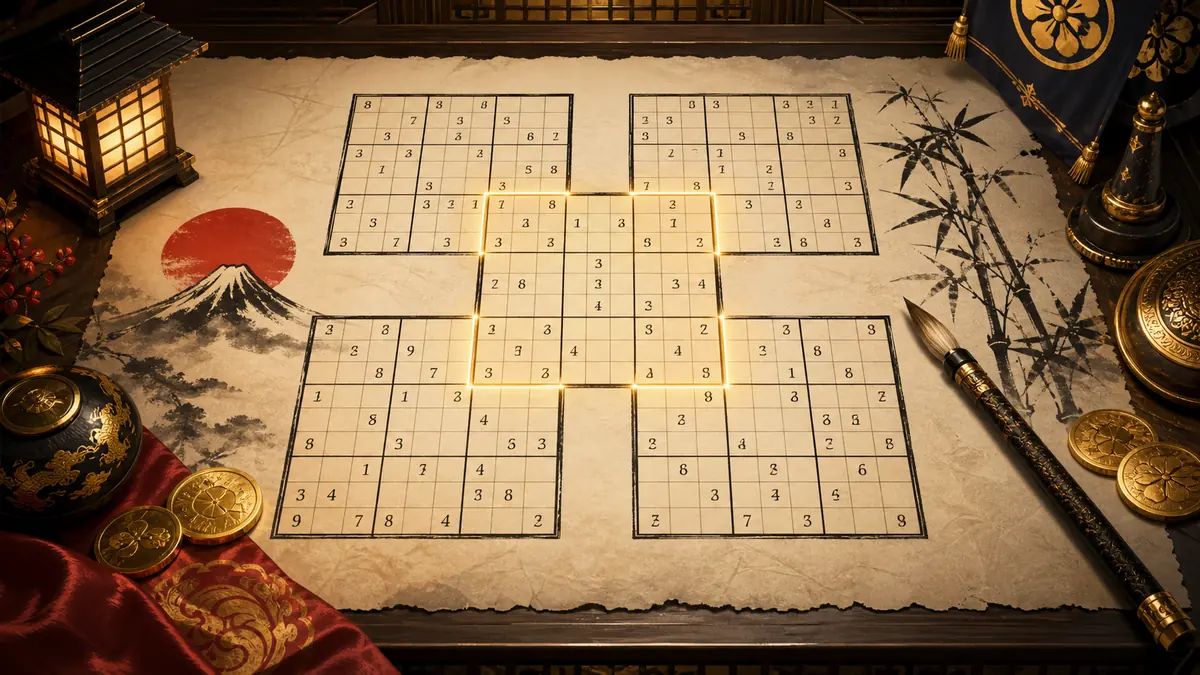
When a Samurai board feels too large, shrink the job. Pick one corner grid, solve the obvious local moves, then inspect the box it shares with the center. Any confirmed digit in that shared box must be read by both grids before you move on.
A good Samurai moment is very plain. The upper-left grid proves a 6 in its lower-right box. That same box is part of the center grid, so the center grid just received a 6. Scan the center row and column touched by that cell before wandering to another corner.
A practical route through the board
Do not try to keep all five grids in your head at once. Work in laps: corner grid, shared box, center consequence, next corner. The lap gives the solve a route instead of a fog.
Notes help, but Samurai punishes note carpet. If every empty cell gets full candidates too early, the overlap that matters gets buried. Start notes around the active handoff zone, then expand only when that area stalls.
| Samurai stage | Best focus | What to avoid |
|---|---|---|
| Opening | Find the corner grid with the most givens. | Jumping between all five grids every few seconds. |
| First overlap | Transfer confirmed digits into the center. | Treating a shared cell as if it belongs to one grid only. |
| Middle solve | Let the center send clues back to corners. | Writing full notes everywhere too early. |
| Endgame | Check every overlap after each placement. | Finishing a corner while ignoring its shared box. |
How to train Samurai in ZUDOKU
Use Samurai for a longer, quieter session. It is not the best warmup before a rushed ranked match, but it is excellent for building endurance and review habits.
For awards, treat one Samurai puzzle as a project: one clean overlap chain, one no-guess recovery, or one completed long-form solve. The awards guide pairs well with this because Samurai progress is usually about consistency, not quick wins.
If Samurai feels heavy, step down to Jigsaw or Hyper for one puzzle, then come back. Both modes train the same idea in smaller spaces: a special house changes the meaning of a normal-looking cell.
How to pace a Samurai solve
Samurai rewards planned movement. Pick a starting corner and stay there until either the grid stalls or an overlap changes. Then move through the shared box into the center grid. If the center creates a new clue, send it back to the corner that shares the affected overlap.
This lap system prevents the most tiring version of Samurai: scanning five grids randomly and feeling that nothing is connected. The puzzle is connected, but only through specific shared regions. Let those regions decide where your attention moves.
Use breaks intentionally. If a long Samurai board starts to blur, pause after completing one lap. A thirty-second reset can save several minutes of repairing bad notes.
| Lap | Focus | Review question |
|---|---|---|
| Corner lap | Find local singles and clean notes. | Did anything enter the shared box? |
| Overlap lap | Transfer shared-cell information both ways. | Which grid owns the next consequence? |
| Center lap | Use incoming clues from corners. | Can the center send a digit back? |
| Endgame lap | Check every shared box after each placement. | Did one move affect two grids? |
When Samurai stalls
Do not widen the search immediately. First ask whether the last overlap was fully transferred. A digit placed in a shared box should be checked in both connected grids. If you checked only the grid that found it, the other grid may still contain the next move.
If every overlap is quiet, choose the grid with the fewest empty cells and solve it like Standard Sudoku for one pass. Samurai is large, but each 9x9 grid still obeys familiar logic.
A long-session checklist
Samurai is the ZUDOKU mode where session quality matters most. A tired solver can keep tapping for a long time while actually reading less of the board. Use a short checklist every few minutes: which grid am I solving, which overlap changed last, and which grid should receive that information?
If you cannot answer those questions, pause. The puzzle has become too wide in your head. Pick one corner, clean its notes, and follow one confirmed digit into the center. One real connection is better than scanning all five grids vaguely.
For clean-award attempts, avoid starting Samurai when you only have a few spare minutes. It is a long-form mode. Give it a calmer slot, then use the result as practice for patience, note hygiene, and no-guess recovery.
For competitive players, Samurai is not about PvP speed. Its value is endurance. It teaches you to keep proof quality alive after the easy singles are gone.
Should you note all five grids?
Usually, no. Full notes across five grids can make Samurai harder to read. Start with local notes in the active grid and the shared box that connects it to the center. Expand notes only after that area stalls.
This keeps the overlap visible. In Samurai, the shared boxes are the story. If notes bury them, you lose the one feature that makes the mode different from five separate Standard puzzles.