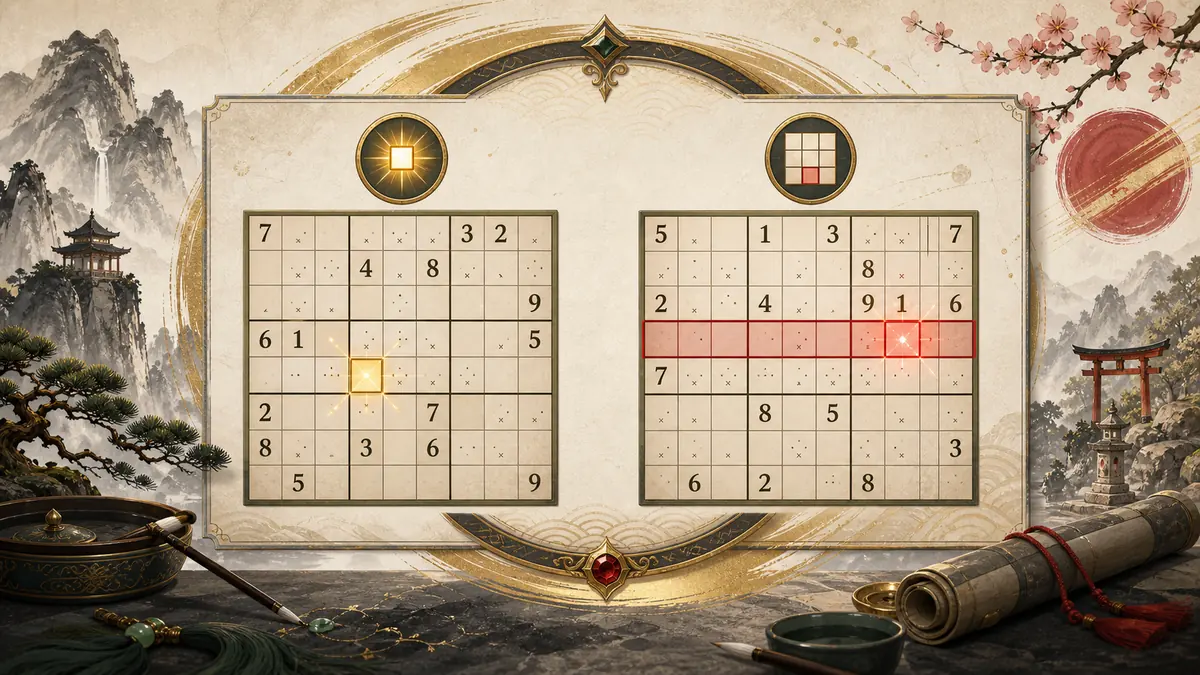
The difference in one sentence
A naked single is a cell with only one possible digit. A hidden single is a digit with only one possible cell inside a row, column, or box. Both are forced moves, but you spot them from opposite directions: cell-first for naked singles, digit-first for hidden singles.
This distinction matters because players often look only for one type. If you stare at empty cells, you may miss a hidden single. If you scan only digits, you may miss a naked single created by candidate cleanup.
| Technique | Question | Proof | Search habit |
|---|---|---|---|
| Naked single | What can this cell contain? | Only one candidate survives | Inspect cells affected by recent placements |
| Hidden single | Where can this digit go? | Only one position is legal | Scan one digit across houses |
| Both together | What changed after this move? | A new forced placement appears | Place, clean notes, rescan |
How to find naked singles
Choose an empty cell and check the row, column, and box. If eight digits are blocked and only one remains, the answer is forced. In puzzles with notes, any cell with one candidate is a naked single.
The best time to search for naked singles is immediately after placing a number. That placement removes a candidate from related cells.
A repeatable singles drill
Open a Standard Sudoku puzzle and do not write notes for the first three minutes. Scan digit 1 across all boxes, then digit 2, and continue through 9. Each time you place a number, restart the scan around that region.
After three minutes, add pencil marks only where the board is congested. Now look for naked singles created by the notes. This drill teaches both directions: digit-first and cell-first.
Common mistakes
The first mistake is placing a number because it feels likely. Singles are not likely; they are proven. The second mistake is failing to rescan after a placement. Sudoku is dynamic. A move changes the board, and that change may reveal the next move nearby.
The third mistake is ignoring boxes. Many beginners scan rows and columns but forget that every 3x3 box is equally powerful.
| Mistake | Why it hurts | Fix |
|---|---|---|
| Likely placement | Creates hidden errors | Require a one-sentence proof |
| No cleanup | Leaves false candidates | Erase candidates after every placement |
| Row-only scanning | Misses box restrictions | Scan row, column, and box together |
| Skipping rescan | Misses chains of singles | Return to the changed region |
A board-reading order for singles
The easiest way to miss singles is to read the board in a different order every time. A fixed order lets your eyes build momentum. Start with boxes, because boxes are small and visually contained. Then move to rows with many filled cells. Then inspect columns that intersect the most active boxes. Finally, scan digits 1 through 9 across the whole board.
This order is not magic; it is a way to reduce decision fatigue. Instead of wondering where to look, you follow the routine and let the board reveal what changed. In ZUDOKU, this is especially useful before PvP, where hesitation costs more than the scan itself.
| Pass | Look at | Single type most likely |
|---|---|---|
| 1 | Nearly complete boxes | Hidden singles |
| 2 | Rows with seven or eight filled cells | Naked singles |
| 3 | Columns crossing active boxes | Both |
| 4 | Digits 1 through 9 globally | Hidden singles by digit |
Singles after every placement
Most beginner guides explain singles as if they appear only at the start of a puzzle. In real solving, singles often appear after another move. You place a 6 in a box, which removes 6 from a row, which leaves one cell with only 4, which then creates a hidden 9 in a column. That chain is why experienced players immediately rescan the changed region.
Think of every placement as a small shockwave. It affects one row, one column, and one box. In variants it may affect more: a diagonal in Sudoku X, a cage in Killer Sudoku, or an irregular region in Jigsaw Sudoku. Singles are often hiding inside that shockwave.
When singles stop working
A board with no visible singles is not asking you to guess. It is asking you to create new information. That usually means pencil marks. Add candidates in the most constrained region, then look again for naked singles and hidden singles. Notes often reveal a single that was invisible when you were trying to hold candidates in memory.
If notes still do not produce a single, the next layer is candidate relationships. Pairs, triples, and line interactions remove candidates, and those removals often create fresh singles. This is why singles remain important even in advanced puzzles: higher techniques usually exist to make the next simple move possible.
Using singles for Daily Dojo
Daily Dojo is a useful place to train singles because the routine repeats. A daily puzzle gives you one board where you can practice clean scanning, compare your time, and notice whether you missed easy forced moves. Do not measure only the finish time. Also ask how many placements came from confident singles before you needed notes.
Over a week, track one metric: first-stall time. That is the moment when simple scanning stops producing moves. If your first-stall time gets later, your singles recognition is improving. If it gets earlier, slow down and rebuild the reading order.
| Daily metric | What it shows | How to improve it |
|---|---|---|
| First-stall time | How long scanning stayed productive | Use a fixed reading order |
| Notes before first stall | Whether you wrote notes too early | Scan boxes before filling candidates |
| Mistakes after singles | Whether proof was rushed | Say the one-sentence reason first |
A singles practice ladder
A good singles ladder starts with comfort and ends with pressure. First, solve an easy Standard puzzle and pause before each placement to name whether it is naked or hidden. Next, solve a medium puzzle and add notes only after scanning stalls. Then play a Daily Dojo puzzle and try to preserve the same proof habit under time pressure.
The ladder works because it isolates one skill across different conditions. If you can find singles in an easy puzzle but miss them in Daily Dojo, the issue is not knowledge; it is pressure. If you miss them in medium puzzles before notes, the issue is likely scan order. If you miss them after notes, the issue is cleanup.
| Ladder step | Puzzle type | Rule | What it reveals |
|---|---|---|---|
| 1 | Easy Standard | Name each single type | Technique understanding |
| 2 | Medium Standard | No notes until scanning stalls | Board-reading strength |
| 3 | Daily Dojo | Keep the same scan order | Pressure control |
| 4 | Ranked warmup | Use proof before speed | Competitive readiness |
How singles connect to hard techniques
Advanced Sudoku techniques can sound disconnected from beginner solving, but most of them are designed to create singles. A pair removes candidates so a cell becomes naked. A pointing pattern removes a digit from a row so a box has only one home. A chain may eliminate one candidate so the final placement becomes simple. The ending is often a single.
This is why singles are worth practicing even after you learn harder patterns. If you do not rescan after eliminations, the board may already contain the answer and you will keep looking for a more complicated technique. Strong solvers are not always using harder logic; they are often better at noticing when hard logic has made the next easy move available.
Singles FAQ
Are naked singles easier than hidden singles?
Usually, yes. Naked singles are visible from the cell because only one candidate remains. Hidden singles require scanning a house and noticing that a digit has only one legal position.
Can a cell be both naked and hidden?
Yes. A placement can be provable in more than one way. A cell might have only one candidate, and that same digit might also be the only legal position in its box.
Should I write notes to find singles?
For easy puzzles, try scanning first. For medium and harder puzzles, notes make naked singles much easier to spot and can reveal hidden singles that are hard to hold in memory.
Why do I miss hidden singles?
Most misses come from scanning too broadly. Pick one digit and one house at a time. If you inspect everything at once, the single disappears into the grid.
Are singles still useful in hard Sudoku?
Yes. Hard techniques often remove candidates so that a single appears. If you do not rescan after an elimination, you can miss the simple move that the advanced logic created.
Final practice note
Singles are not beginner-only moves. They are the heartbeat of the solve. The difference between a new player and a strong player is often how quickly they notice a single after the board changes. That means every placement is also a scanning opportunity.
For your next few ZUDOKU sessions, make a tiny habit: after each number, ask what became easier. Did a row lose its last uncertainty? Did a box now have only one legal square for a digit? Did notes collapse to one candidate? This keeps your attention local and turns singles into momentum rather than isolated discoveries.
Useful references
The basic constraints behind singles are covered in Sudoku. For the structure that makes these constraints interesting, see Mathematics of Sudoku. Players who enjoy competition can explore the World Puzzle Federation.