Why this matters
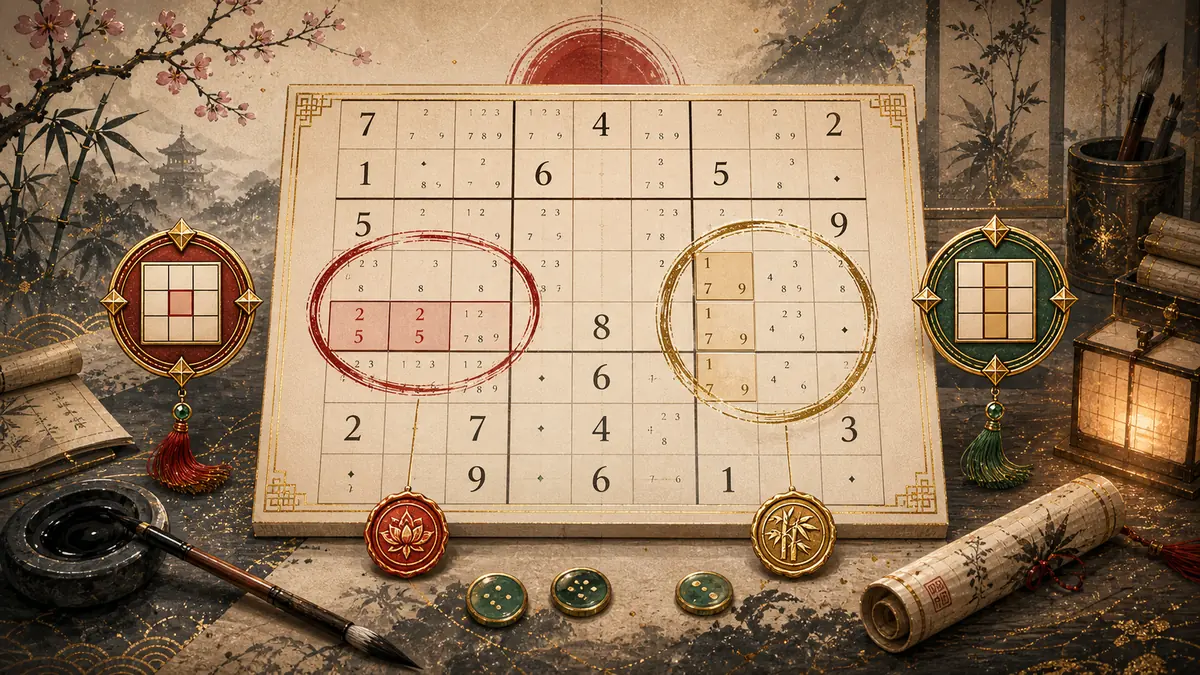
Hidden sets are the moment where notes stop being decoration and start paying rent. If the digits 2 and 7 can appear only in the same two cells of a row, those two cells are reserved for 2 and 7. Any other candidates written in those cells are pretending to be possible, and they can be erased.
This matters because hidden sets often turn a muddy middle game back into a normal solve. One cleanup can reveal a naked single, shrink a box, or make a locked candidate obvious. It also prevents the bad habit of staring at individual cells while the house-level answer is already visible.
Use this guide with one board open. You are looking for one house where a digit appears in only two or three places, not trying to memorize every possible pattern name.
Core idea
For hidden pairs, scan a house by digit instead of by cell. In a column, maybe 4 can go only in row 2 or row 8, and 9 can also go only in row 2 or row 8. Those two cells now belong to 4 and 9 in some order, even if the notes currently say 1, 4, 6, 9 and 3, 4, 8, 9.
A hidden triple is the same idea with three digits and three cells. It is harder to see because the cells may each contain several extra marks. The proof is still house-level: those three digits have nowhere else to live inside that row, column, or box.
After you find the hidden set, the useful move is usually cleanup, not placement. Remove the extra candidates inside the reserved cells, then rescan the changed area.
A house-first routine
Pick one row, column, or box with complete notes. Do not inspect every cell at once. Count the possible homes for one digit, then the next digit, and keep an eye out for matching locations.
If two digits share the same two homes, you have a hidden pair. If three digits share the same three homes, you may have a hidden triple. The table below is the slow version; with practice, your eyes start grouping the locations automatically.
| Step | Action | What proves the set |
|---|---|---|
| 1 | Choose one completed-note house. | You know the candidates are current. |
| 2 | Mark where each missing digit can go. | A digit has only two or three positions. |
| 3 | Compare position lists. | Two or three digits share the same cells. |
| 4 | Clean those reserved cells. | Other candidates inside them disappear. |
| 5 | Rescan the house. | A single, pair, or locked clue may appear. |
Common mistakes
The most common mistake is confusing a naked pair with a hidden pair. A naked pair starts from two cells that already contain only the same two candidates. A hidden pair starts from two digits that appear only in the same two cells, even if those cells still have extra candidates written in them.
The second mistake is cleaning the wrong side of the pattern. With a hidden pair, you remove extra candidates from the pair cells. You do not remove the pair digits from every other cell because those digits were already absent everywhere else in that house.
| Mistake | Why it hurts | Better habit |
|---|---|---|
| Looking only at cells | The hidden set is a digit-position pattern. | Count homes for each missing digit. |
| Trusting stale notes | A false candidate can invent a fake set. | Clean the house before searching. |
| Erasing outside the reserved cells | Hidden pairs work differently from naked pairs. | Remove extra marks inside the set cells. |
| Forcing a placement too early | A hidden pair usually proves cleanup first. | Rescan after cleanup before tapping. |
Digit-position filter
When a row or box looks noisy, write the missing digits as tiny position lists in your head. It can be as simple as "2 lives in cells 3 or 8; 7 lives in cells 3 or 8." That sentence is the hidden pair.
| Question | Useful answer | If not |
|---|---|---|
| Are the notes current in this house? | Recent placements have been cleaned. | Update notes before searching. |
| Which digits have only two homes? | Two digits share the same two cells. | Try a different house. |
| Which digits have only three homes? | Three digits share a three-cell group. | Leave triples until notes are cleaner. |
| What changed after cleanup? | A new single or smaller candidate set appears. | Move on without forcing it. |
ZUDOKU practice path
Use Standard Sudoku for the first few hidden-set sessions. The technique is easiest to hear when cages, diagonals, thermometers, and extra regions are not also talking.
After that, try a Daily Dojo puzzle and keep one rule: no hidden-set hunting until the notes in a house are clean. Timed play makes messy notation tempting, and this technique punishes messy notation quickly.
If you care about awards, pair this with clean-solve or no-hint goals. Hidden sets are not flashy, but they are excellent for proving a board without guessing.
A practical drill for this guide
Open a medium Standard puzzle and play normally until singles slow down. Then choose one box with complete notes. For each missing digit, point to the cells where it can still go. Do not place anything during this pass; your job is only to find matching position lists.
If you find a hidden pair, clean the extra candidates from the two reserved cells and stop. Watch what appears next. If nothing appears, the drill still worked: you practiced seeing the structure without inventing a move.
For hidden triples, be stricter. Only look for them in a house where the notes are already reliable. Triples are useful, but they are also a good way to fool yourself when the candidate layer is dirty.
| Drill phase | Action | Success signal |
|---|---|---|
| Warm up | Solve until singles slow down. | The board needs candidate work. |
| Choose | Pick one clean row, column, or box. | The house has current notes. |
| Count | List homes for each missing digit. | Two or three lists match. |
| Clean | Erase extra marks inside reserved cells. | The house becomes easier to read. |
What to measure while practicing
Do not measure hidden-set practice by finish time alone. A faster solve can still miss the lesson if you guessed through the middle. Track something closer to the skill: how many houses you checked cleanly, how many false notes you removed, or whether a hidden set created a real follow-up move.
A good note after the puzzle is short: "Box 6 had a hidden 3/8 pair; after cleanup, row 7 gave a single." That is enough. You are training recall, not writing a report.
| Training goal | Measure | Why it helps |
|---|---|---|
| Accuracy | Mistakes or near-mistakes | Shows whether proof is stable |
| Speed | Time to first strong move | Rewards better opening scans |
| Notes | Stale candidates removed | Keeps the grid readable |
| Variant awareness | Extra-rule checks remembered | Makes Standard Sudoku feel natural |
| Pressure | Recoveries before hints or guesses | Builds calm under stress |
How this skill changes under pressure
Under a timer, hidden pairs feel expensive because they ask you to slow down and count. The trick is not to search every house. Use them only after normal scanning and obvious candidate cleanup stop producing moves.
In ranked PvP, a hidden pair is worth the pause only if the house is ready. If the notes are incomplete, keep scanning. If the notes are clean and two digits are boxed into the same two cells, take the cleanup and move on.
| Pressure signal | What to protect | One useful response |
|---|---|---|
| The timer makes you jump between houses | Position counting | Finish one house before moving. |
| Notes look crowded | Candidate honesty | Clean the last changed house first. |
| You see a possible pair but feel unsure | The proof | Say the two digits and two cells before erasing. |
Mistake recovery map
If a hidden-set attempt goes wrong, rebuild the house instead of guessing forward. Choose the row, column, or box where the pattern was supposed to exist and recreate the notes from the current givens and placements.
Most false hidden pairs come from one stale candidate. Once that false mark is removed, the pattern either becomes real or disappears. Both outcomes are useful because the board is honest again.
| Stuck signal | First pass | Second pass |
|---|---|---|
| The pair does not lead anywhere | Rebuild the house notes. | Check whether the set was real. |
| A triple feels forced but fuzzy | List digit homes aloud. | Skip it if one digit has a fourth home. |
| Cleanup creates no progress | Rescan the same house for singles. | Move to a different constrained house. |
Seven-day practice plan
Give this one week if it feels new. Keep the sessions short; hidden-set training gets worse when you are tired and trying to see patterns in every row.
After seven days, you should not be finding hidden pairs everywhere. You should simply know when the board is asking for a digit-position scan.
| Day | Focus | Session |
|---|---|---|
| 1 | Observe | Find one hidden pair from a solved example or replay. |
| 2 | Clean notes | Rebuild candidates in three boxes. |
| 3 | Pairs | Search only for two-digit position matches. |
| 4 | Triples | Try triples only in one clean house. |
| 5 | Pressure | Run one Daily Dojo and note whether you used the scan. |
| 6 | Review | Replay one miss and find the stale candidate. |
| 7 | Normal play | Solve without forcing the technique. |
Useful references
Hidden pairs and triples use only the standard Sudoku houses, so Wikipedia on Sudoku is enough for the rule background. If you want the bigger structural picture behind candidate patterns, Mathematics of Sudoku is the better follow-up. For the wider puzzle scene outside one app or site, see the World Puzzle Federation.
FAQ
Do hidden pairs require full notes?
Usually, yes. You can sometimes spot them from memory, but reliable hidden pairs depend on knowing where each digit can still go inside one house.
How are hidden pairs different from naked pairs?
A naked pair is visible from the cells: two cells contain only the same two candidates. A hidden pair is visible from the digits: two digits have only the same two possible homes, even if those cells contain extra notes.
Should beginners learn hidden triples?
Not first. Learn singles, pencil-mark cleanup, and hidden pairs before spending much time on triples. Triples are useful, but they are much easier to misread.
What should I read next?
Read Naked Pairs and Triples to compare the sister pattern, or use the Sudoku Strategy Roadmap if you want the larger order.