Why this matters
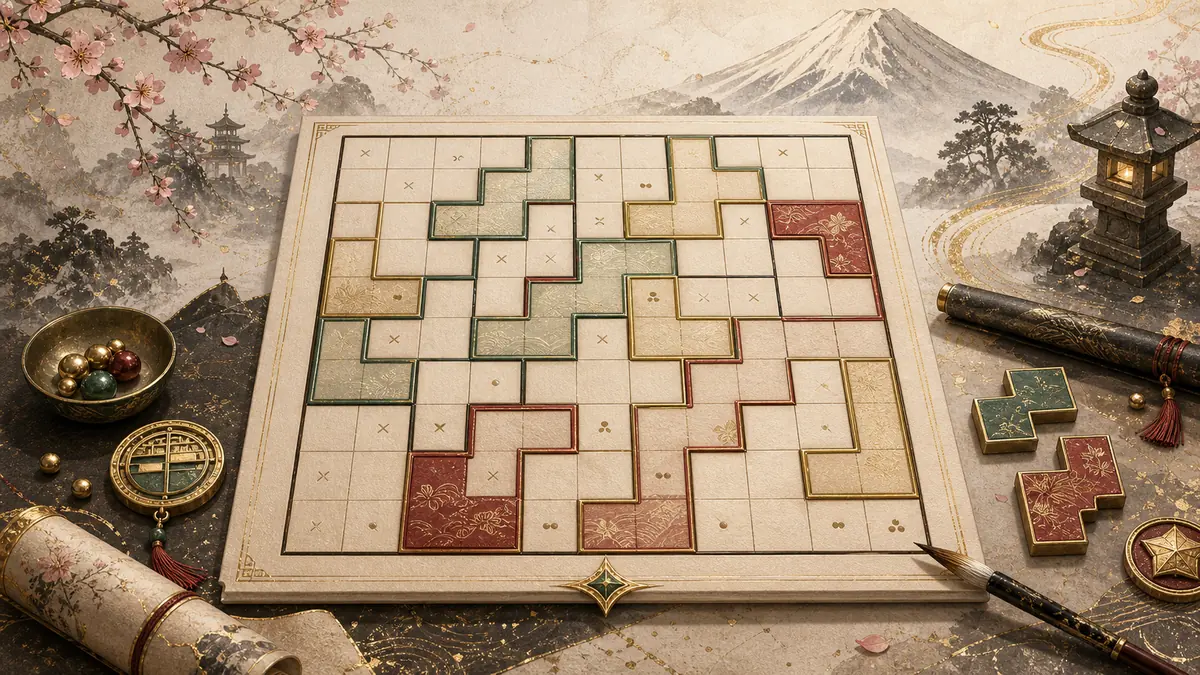
Jigsaw Sudoku keeps the row and column rules but replaces familiar 3x3 boxes with irregular regions. That one change is enough to make old scanning habits unreliable.
The important shift is visual. In Standard Sudoku, the square boxes become automatic. In Jigsaw, those old boxes are gone, but your eyes may still try to use them. The printed outline is the region now, even when it bends, stretches, or crosses the place where a square box would normally end.
Keep a board open while you read this guide. The fastest way to learn Jigsaw is not to memorize shape names. Trace one region, list its missing digits, and test how row and column conflicts change that exact outline.
Core idea
The core idea is region-first reading. Instead of asking which 3x3 box needs a digit, trace the irregular outline and ask what that exact region still needs.
For example, suppose a bent region is missing 2, 6, and 9. If every open cell except one already sees a 6 in its row or column, that remaining cell is not merely a good-looking fit. It is the region's only legal 6.
This proof habit also supports ZUDOKU awards. Clean solves, hintless solves, Daily Dojo streaks, and mode progress are easier when each move comes from a named reason instead of a familiar-looking pattern.
Step-by-step routine
Use this routine when the board stops offering obvious singles. It gives your eyes a next place to go instead of a full-grid search.
If an easy move appears, take it and then come back to the changed region. Jigsaw rewards the same discipline as Standard Sudoku, but the changed house may have a stranger shape.
| Step | Action | What to look for |
|---|---|---|
| 1 | Trace one irregular region border | The exact cells that belong together |
| 2 | List the missing digits for that region | Two- or three-digit gaps you can test |
| 3 | Cross-check rows and columns | Digits blocked from all but one cell |
| 4 | Update only the affected candidates | Notes near the changed region, not everywhere |
| 5 | Say the proof before tapping | A placement you can explain in one sentence |
Common mistakes
Most Jigsaw mistakes come from using square-box memory on a board that no longer has square boxes. The move can look familiar and still be wrong because the real region bends away from the place your eye expected.
If the same mistake appears twice, make one small rule for the next puzzle. "Trace before notes" is better than "be more careful."
| Mistake | Why it hurts | Better habit |
|---|---|---|
| Seeing ghost 3x3 boxes | The wrong cells get treated as one house | Trace the printed region border first |
| Rushing the first possible move | A likely digit is not a proof | Name the region, row, or column that proves it |
| Writing full notes too early | Noise hides the shape clues | Use targeted notes inside crowded regions |
| Leaving a changed region behind | New singles often appear in that outline | Rescan the region after every placement |
Irregular-region map
Use this quick region map before you ask for a hint or turn a stall into a guess.
| Question | Good answer | If not |
|---|---|---|
| Which outline am I reading? | The exact region cells are clear | Trace the border again before scanning digits |
| Which digits are missing from that region? | A short list is visible | Write the missing list before candidate notes |
| Which row or column blocks a digit? | At least one candidate disappears | Move to a more crowded region |
| What move is proven? | Placement or elimination is explainable | Do not tap yet |
A small worked example
Imagine an irregular region shaped like a hook. It has six filled cells and is missing 2, 5, and 8. Two of the empty cells sit in row four, and the third empty cell sits in row six.
Now suppose row four already contains a 5. Both row-four cells are blocked from taking 5, so the row-six cell is the only place in that region where 5 can go. This is a clean Jigsaw move because the proof uses the region border and the row together.
Notice what did not happen: you did not need an advanced pattern, and you did not need to fill candidates across the whole grid. You traced one outline, listed three missing digits, and let one row remove a digit from two cells.
ZUDOKU practice path
Begin with Jigsaw for this topic, and use Standard Sudoku as a warmup if your basic scan feels rusty.
Then move to Daily Dojo for one pressure solve. Save ranked PvP for after the warmup, because competitive pressure rewards routines that are already stable.
If you are chasing the ZUDOKU awards system, choose one award behavior for the session: clean solve, hintless solve, speed improvement, mode practice, or streak consistency.
A practical drill for this guide
The fastest way to make irregular region reading useful is to isolate it for one puzzle. Do not try to improve every Sudoku skill at the same time. Open Jigsaw, set a calm pace, and judge only the region habit.
For this topic, the drill is simple: trace each region before placing candidates. Say the reason for each placement before you commit. If you cannot say the reason in one sentence, pause and check the active row, column, box, region, cage, diagonal, or relationship again.
This may feel slow for a few puzzles. That is normal. Skill becomes fast after the proof becomes familiar. The aim is not to finish the first training board quickly; the aim is to make the correct scan feel automatic later.
End the drill with one short note. Write the moment where the board became easier to read: maybe a bent region trapped a 7, or a long region forced all 3s into one row. That note turns the advice into a repeatable habit.
| Drill phase | Action | Success signal |
|---|---|---|
| Open | Choose Jigsaw and ignore the timer | Attention is calm |
| Focus | trace each region before placing candidates | The next check is obvious |
| Proof | Name the reason before placing | Every move has a named reason |
| Review | Write one sentence after the solve | A repeatable habit is visible |
What to measure while practicing
Good Sudoku practice needs a measurement, but the measurement should match the skill. Finish time is helpful for speed work, but it is a poor measurement for learning irregular regions.
Track one useful signal per Jigsaw session: time to first stall, number of region-border checks remembered, stale notes removed, or whether the region rule was named before placement.
Use small numbers. You do not need a spreadsheet to improve. One number and one sentence per session is enough. The number tells you what happened. The sentence tells you why it happened.
This also connects practice to ZUDOKU awards: the badge arrives later, but the habit can be measured today.
| Training goal | Measure | Why it helps |
|---|---|---|
| Accuracy | Mistakes or near-mistakes | Shows whether proof is stable |
| Speed | Time to first strong move | Rewards better opening scans |
| Notes | Stale candidates removed | Keeps the grid readable |
| Variant awareness | Extra-rule checks remembered | Makes Jigsaw feel natural |
| Pressure | Recoveries before hints or guesses | Builds calm under stress |
How this skill changes under pressure
Pressure exposes Jigsaw habits quickly. In a relaxed puzzle you can pause and fix a missed outline; in Daily Dojo or ranked PvP, the same miss costs momentum.
Keep one proof ritual: name the rule before placing, then check what changed. It is small, but it prevents repair work.
Use the clock as feedback. If proof quality drops, slow one move down and rebuild from the tightest clue.
Before ranked play, test Jigsaw in a calm puzzle first. PvP exposes messy habits quickly, so the warmup is part of the strategy.
| Pressure signal | What to protect | One useful response |
|---|---|---|
| The region border feels slow | The shape you are reading | Pause for one named proof |
| The board looks crowded | Candidate cleanup | Clean the last changed region first |
| The timer pulls attention | Scan order | Check one region, row, or column fully |
Mistake recovery map
Every Jigsaw session needs a recovery map. Without one, a stall turns into guessing. With one, the stall becomes a short checklist. The miss is usually not ability; it is one skipped pass through the right outline.
Start recovery at the last changed region. Then check whether that region removes a candidate you forgot to clean.
If that area gives nothing, zoom out one layer, return to digit scanning, and only then widen the search.
Use a hint only after that recovery pass, so the hint becomes feedback rather than a shortcut.
| Stuck signal | First pass | Second pass |
|---|---|---|
| No clear placement | Return to the last changed region | Scan one digit through rows and columns |
| Notes feel stale | Clean affected candidates | Look for a pair inside the outline |
| The region border was missed | Trace it aloud | Apply it to the most crowded region |
Seven-day practice plan
Use this seven-day plan if irregular regions are the skill you want to sharpen this week. Keep the sessions short enough that you can actually repeat them.
The week starts slowly on purpose: see the region shapes, repeat the outline scan, add notes, add pressure, then review whether the habit survived a normal solve.
If you miss a day, continue with the next session. Attention matters more than a perfect calendar.
After seven days, decide whether irregular region reading still needs focused practice. If it does, repeat the plan with harder puzzles. If it feels stable, move to another guide from the ZUDOKU blog and keep the habit alive in normal play.
| Day | Focus | Session |
|---|---|---|
| 1 | Observe | One slow Jigsaw puzzle with no speed target |
| 2 | Repeat | Use the same scan or rule routine |
| 3 | Notes | Track candidates only where needed |
| 4 | Pressure | Try Daily Dojo or a light timer |
| 5 | Variation | Raise difficulty or use a related mode |
| 6 | Review | Replay one mistake and name the missed clue |
| 7 | Test | Solve normally and see whether the habit appears |
Useful references
For broad Sudoku background, see Wikipedia on Sudoku. For deeper structure, Mathematics of Sudoku explains why the grid supports so many solving paths. For organized puzzle culture, the World Puzzle Federation is a useful non-competitor reference.
FAQ
Who should read this Jigsaw guide?
Anyone who keeps accidentally using the old 3x3 boxes. That mistake is normal; Jigsaw is mostly a visual retraining exercise before it becomes a strategy problem.
How should I practice irregular regions?
Play one calm Jigsaw puzzle and make the region border the whole goal. Trace before notes, place only when the printed region and the crossing row or column prove the move, then review one missed outline.
Should I use notes?
Yes, but not everywhere at once. Start notes inside the active region or around the last changed area. Full-board notes too early can hide the very shape you are trying to learn.
How does this connect to awards?
Jigsaw awards reward the same behaviors as good Jigsaw solving: clean proof, mode patience, and fewer hint-driven recoveries. The badge is later; the region habit is today.
What should I read next?
Read Sudoku Scanning Techniques if your eyes jump around, or Pencil Marks if your candidates get noisy.