What scanning actually means
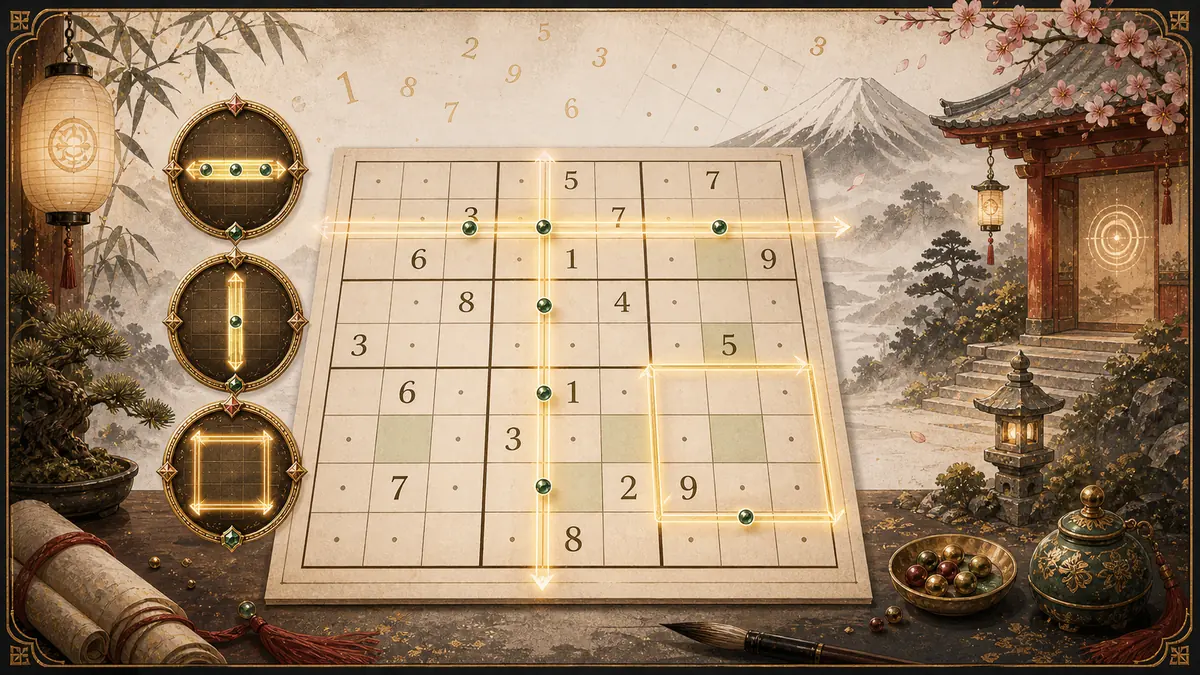
Scanning is not staring at the grid until something pops out. It is a deliberate order of attention. Choose one house, one digit, or one recent placement, then ask a narrow question. "Where can 7 go in this box?" is much easier to answer than "what is the next move?"
On a fresh ZUDOKU board, scanning usually starts before notes. You are looking for cheap information: crowded rows, boxes with five or six givens, digits that already appear often, and placements that immediately change nearby cells.
Good scanning can feel almost boring. That is a compliment. You do not need fireworks every ten seconds. You need a routine that catches the simple things consistently, because missed simple things are what make medium puzzles feel unfair.
The row-column-box pass
Start with the houses, not the empty cells. Pick a row with several numbers already placed and list the missing digits. Then test one missing digit against the columns crossing that row. If the digit is blocked in every empty square except one, place it.
Do the same with columns and boxes. A box with six filled cells is often friendlier than an empty-looking row because three missing digits can be checked quickly. The point is to shrink the board into local questions your eyes can finish.
| Pass | Look at | Ask | When to move on |
|---|---|---|---|
| Row pass | Rows with many givens | Which missing digit has one legal square? | No row has a forced square. |
| Column pass | Columns with many givens | Which empty cell is most restricted? | The column gives no single. |
| Box pass | Boxes with 5+ givens | Which missing digit is blocked by crossing lines? | All missing digits have multiple homes. |
The digit scan
After the house pass, scan one digit across the whole grid. Choose a digit that is already common. If six 7s are placed, the remaining three 7s are often easier to find than a rare digit with only two clues.
For each box, ask where that digit can still live. Existing rows and columns block cells like gates. If a box has one legal square left for the digit, that is a hidden single. This is one of the fastest ways to move through early and middle-stage Standard Sudoku.
Digit scanning is also useful because it creates rhythm. You are not bouncing randomly between cells. You are following one number until the board stops giving information, then choosing another number.
Scan what just changed
Every placement changes exactly three classic houses: its row, its column, and its box. In variants, it may also change a cage, diagonal, thermometer, irregular region, or overlap. The next move is often near the last move because those houses lost a candidate.
Here is the practical habit: after you place a digit, do not immediately jump across the board. Check the row. Check the column. Check the box. Remove stale candidates if you are using notes. Only then return to your broader scan.
| After placing... | Check first | Likely result |
|---|---|---|
| A digit in a crowded row | Other empty cells in that row | A naked single or blocked digit |
| A digit in a crowded box | Remaining cells in the box | A hidden single |
| A diagonal digit in Sudoku X | The same diagonal | Removed diagonal candidate |
| A cage digit in Killer | The remaining cage total | New combination limit |
When notes should start
Notes are not a failure. They are a memory tool. The mistake is starting full notation before the board has been read. If you write every candidate in every empty cell too early, the grid becomes busy before you have collected the easy clues.
A better timing rule is this: start notes when scanning stops producing placements in a specific area. Mark that area, not the entire puzzle. If a box is stuck, note the box. If a digit has only a few possible homes, mark that digit. Targeted notes are easier to keep clean.
When you place a number, clean notes immediately. In ZUDOKU, the Notes control is useful because it lets you shift from pure scanning into candidate work without leaving the board. The best notes still need maintenance.
A 10-minute ZUDOKU scanning drill
Open Standard Sudoku and ignore the timer for the first puzzle. For three minutes, do only the row-column-box pass. For the next three minutes, scan one common digit across all boxes. For the final four minutes, place normally, but after every placement scan only the changed row, column, and box before looking elsewhere.
At the end, write one sentence: "I missed..." or "The board opened when..." That sentence turns a finished puzzle into feedback. If the board opened after a digit scan, practice digit scans tomorrow. If you missed changed areas, build that habit before chasing harder techniques.
| Minute | Rule | What you learn |
|---|---|---|
| 0-3 | Only rows, columns, boxes | Which houses are naturally strong |
| 3-6 | One digit across all boxes | How hidden singles appear |
| 6-10 | Rescan changed areas | Whether placements create momentum |
| After | Write one sentence | The next practice focus |
Scanning under pressure
Pressure makes bad scanning louder. In Daily Dojo, a visible result can make you skip the slow opening pass. In ranked PvP, another player moving fast can make a guess feel like a strategy. It usually is not.
Use a tiny reset: pick one digit, scan three boxes, and place nothing unless the digit has one legal home. If that finds nothing, pick one crowded row or box. This reset takes seconds, but it gives your attention a clean shape again.
Speed should come from recognizing familiar scans faster, not from abandoning the scans. The faster players usually are not doing magic. They are repeating a small order of checks with less hesitation.
Common scanning errors
The most common error is checking only the house you like. Some players love rows and forget boxes. Others keep circling boxes and forget that a column can block the last square. A complete scan needs all three classic houses.
The second error is moving on too quickly after a placement. A new number is not just a solved cell; it is a signal. It removes that digit from related houses and can create an immediate follow-up. If you do not check the changed area, you may miss the easiest move on the board.
| Error | What it sounds like | Better question |
|---|---|---|
| Row tunnel vision | I checked the row, so it must fit. | What do the column and box say? |
| Box tunnel vision | This box has only two spaces. | Do crossing rows or columns settle it? |
| Stale notes | The candidate was written earlier. | Does it still survive after the last placement? |
| Random searching | I am just looking around. | Which digit or house am I testing? |
Where to go next
If scanning still feels new, read How to Play Sudoku and play easy Standard boards until you can explain simple placements. If scanning works but the middle of the puzzle stalls, move into pencil marks and candidate cleanup.
If you want a variant that tests scanning without changing the grid shape too much, try Sudoku X. If you want arithmetic constraints, try Killer Sudoku. If you want a daily pressure test, use Daily Dojo after one calm warmup board.
Useful references
For broad Sudoku background, see Wikipedia on Sudoku. For deeper structure, Mathematics of Sudoku explains why the grid supports so many solving paths. For organized puzzle culture, the World Puzzle Federation is a useful non-competitor reference.
FAQ
Should I scan before writing notes?
Yes. Scan first, especially on easy and medium puzzles. Notes are most useful after the easy placements slow down.
Which digit should I scan first?
Start with a digit that already appears often. A digit with many placements has fewer remaining homes, so hidden singles are easier to spot.
How do I know when scanning is finished?
It is finished for the moment when rows, columns, boxes, common digits, and the last changed area stop producing forced moves. Then add targeted notes instead of filling the whole board automatically.
Does scanning help in Killer Sudoku?
Yes, but Killer adds cage totals. Scan the normal houses, then check whether a cage total or 45-rule clue changes the same area.