
Sudoku variants · An interactive read
Killer Sudoku combinations: from a sum to a legal placement
Build complete cage lists, filter them against cell candidates, and understand what a surviving combination actually proves.
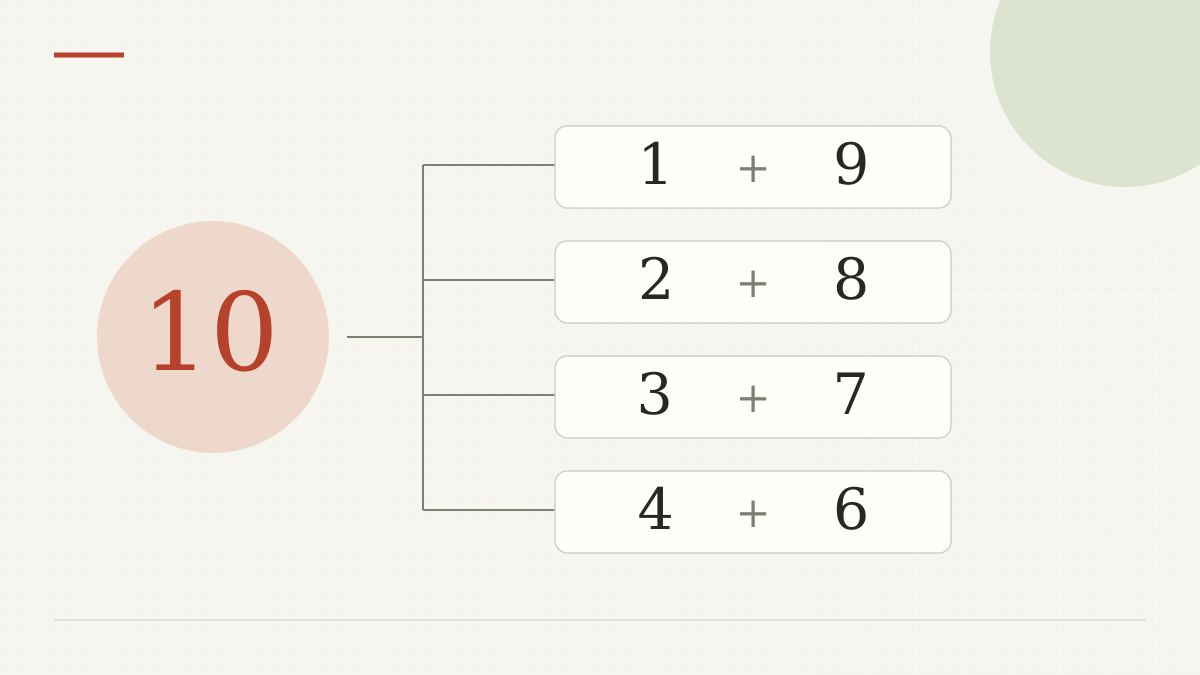
The idea to take away
A combination is an unordered digit set. It survives only if at least one assignment fits every cell; a digit becomes a placement only when every surviving assignment puts it there.
Start with the right mathematical object
A cage marked 10 does not have one universal list of answers. Two cells, three cells and four cells create different questions. Record the number of unfilled cells, their remaining total and any digits already used in the cage. Then build a list for that exact situation.
The no-repeat condition is part of the cage rule, not an optional shortcut. [1] A two-cell total of 10 admits {1,9}, {2,8}, {3,7} and {4,6}. The tempting fifth pair, {5,5}, is illegal. Writing the smaller digit first avoids listing each set twice.
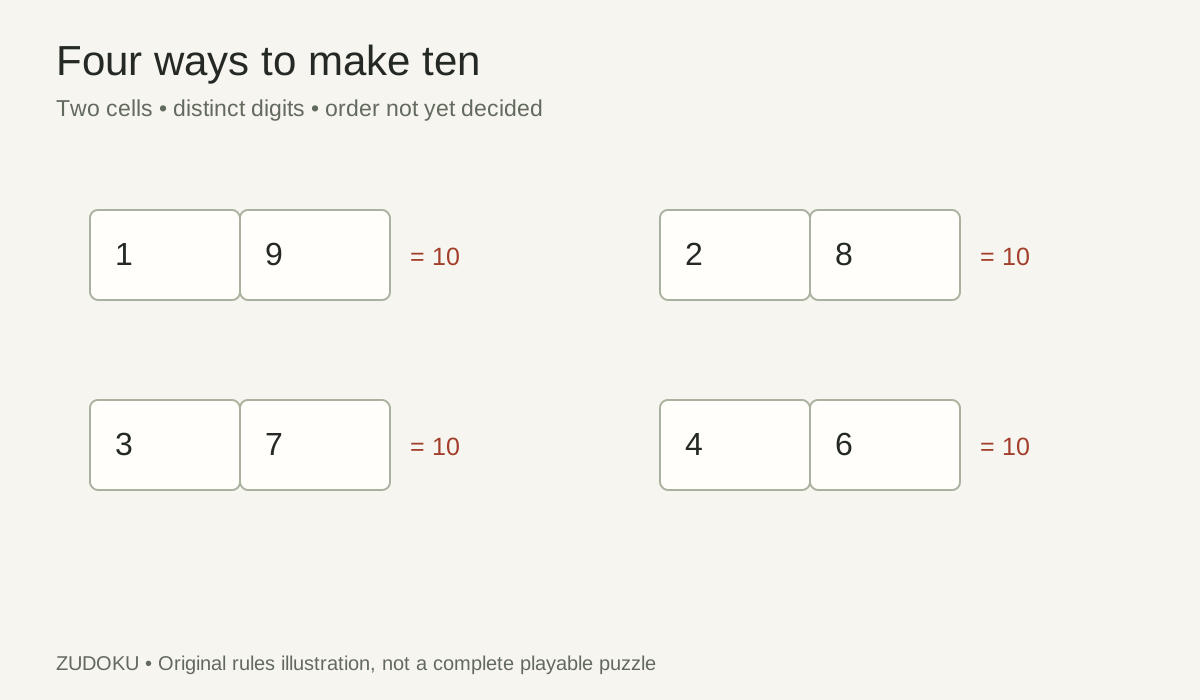
These four sets still represent eight ordered assignments before other restrictions apply. Treating the first number in a written set as the first cell’s value invents an order that the clue did not supply.
Make the list complete before trusting it
For two cells, a simple method is to try the smaller digit from 1 upward, calculate the partner, and retain it only when the partner is larger and at most 9. For three cells, choose the smallest digit first, then the next larger digit, and calculate the third. This ordering makes omissions easier to notice.
For example, a three-cell total of 10 gives exactly {1,2,7}, {1,3,6}, {1,4,5} and {2,3,5}. There is no combination starting with 3 because the smallest three distinct values from that starting point are 3+4+5=12. This is a useful bound, rather than a memorised exception.
A puzzle publisher’s combination tool similarly asks for both the number of unknown cells and their total. [2] You can use a list as a check, but the next stage still requires the positions on your own board.
A quick feasibility check can catch a copied label before you enumerate. Three distinct digits have minimum total 1+2+3=6 and maximum total 7+8+9=24. A three-cell cage labelled 5 or 25 would violate those bounds. For a partly filled cage, tighten the check using the unused digits, because the smallest or largest available values may already be excluded.
Filter assignments, not just ingredients
Suppose a sum-10 cage contains A with candidates {1,2,4}, and B with {6,7,9}. Try each supported pair. The assignment A=1, B=9 works; A=4, B=6 also works. A=2 would need B=8, which is unavailable. B=7 would need A=3, also unavailable.
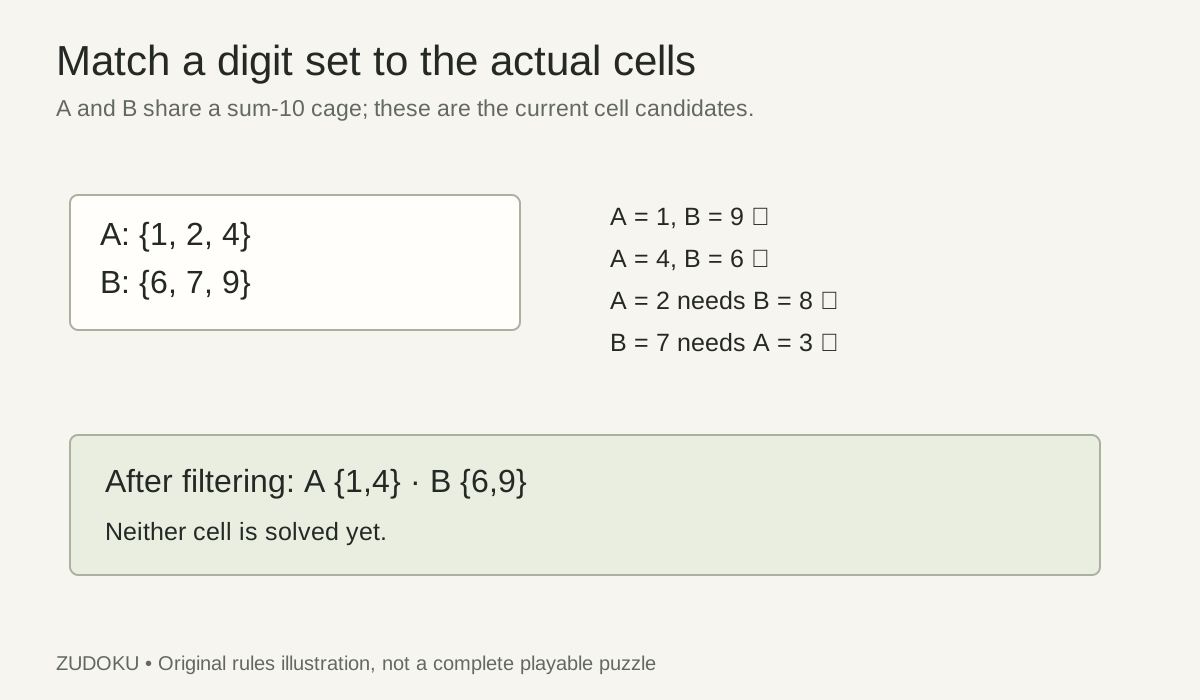
Remove 2 from A and 7 from B. Keep both surviving possibilities: A is not automatically 1 just because that assignment was tested first. This is a successful deduction even though it has not yet placed a digit.
With three or more cells, check that all digits can fit simultaneously. A set containing three digits is impossible if two of those digits are both forced into the same one cell. Finding an individual home for each digit separately is insufficient if those homes collide.
Placed digits change the problem
Imagine a three-cell sum-16 cage with a confirmed 7. The two remaining cells total 9, and neither can repeat 7. Distinct pairs for 9 are {1,8}, {2,7}, {3,6} and {4,5}; remove {2,7} because the cage already uses 7. Then filter the other pairs against their cells.
House arithmetic can provide a similar remaining total. The 45-rule reference explains why complete-house coverage matters. [3] When cages leave two cells totaling 9, do not assume those cells are themselves a new no-repeat cage. Their relationship comes from their actual row, column, box or original cage. In one row they cannot match; across unrelated houses they might.
Three different conclusions
Keep these statements separate in your notes. A digit may appear in some surviving sets, in every surviving set, or in the same cell in every surviving assignment. Only the last statement places that digit. The middle statement can still be powerful: if the entire cage lies in one row, a digit guaranteed somewhere in that cage is excluded from the rest of that row.
If the cage crosses rows, that row exclusion does not follow automatically. You need the guaranteed digit’s possible positions all to lie in the relevant row. Track where the digit can go, not merely whether it appears in the cage’s ingredient list.
For a compact practice check, take one cage and write its sets beside the grid. Whenever a cell loses a candidate, cross out only the assignments that used it. If every assignment disappears, revisit the last removal before making another placement.
Test the difference between a set and a placement
These questions use the same small totals as the worked examples so that the reasoning stays visible. A complete list is useful only when you can explain how it interacts with the cells.
Go to the evidence
Sources & further reading
Research checked on 14 October 2026. Follow the original sources to explore the evidence and its limits.
- Killer Sudoku Online — Rules
Original puzzle publisher specifies cage totals and distinct digits, including across houses.
- DKM Games — Killer Sudoku help
Game publisher describes cage uniqueness and distinguishes cage combinations from basic candidates.
- Killer Sudoku Online — Solving strategies
Publisher’s explanation of complete-house totals and restricted cage sums. Numerical examples here are independently enumerated.
Keep exploring