History & culture · An interactive read
How Sudoku travelled the world
From Number Place in an American magazine to Nikoli, Wayne Gould and a world championship: the documented journey behind the familiar grid.
The idea to take away
Modern Sudoku travelled through American puzzle publishing, Japanese naming and design, and international newspaper distribution. Its mathematical relatives are older; the familiar modern puzzle is not an ancient Japanese invention.
A modern puzzle with a well-travelled name
The name sounds Japanese. The grid looks timeless. Put those together and it is easy to imagine Sudoku arriving from an ancient tradition. Its documented modern story is much more recent: an American magazine puzzle, a Japanese publisher's careful presentation, and a newspaper breakthrough helped turn the same basic idea into an international pastime. [1] [2]
That journey is more interesting than a single invention date. A puzzle can be created, named, refined and introduced to new readers by different people. Sudoku gives each of those contributions a place in its story. Follow the dates below as publishing milestones, rather than a claim that nobody had ever explored a related grid before.
Latin squares are relatives, not the whole story
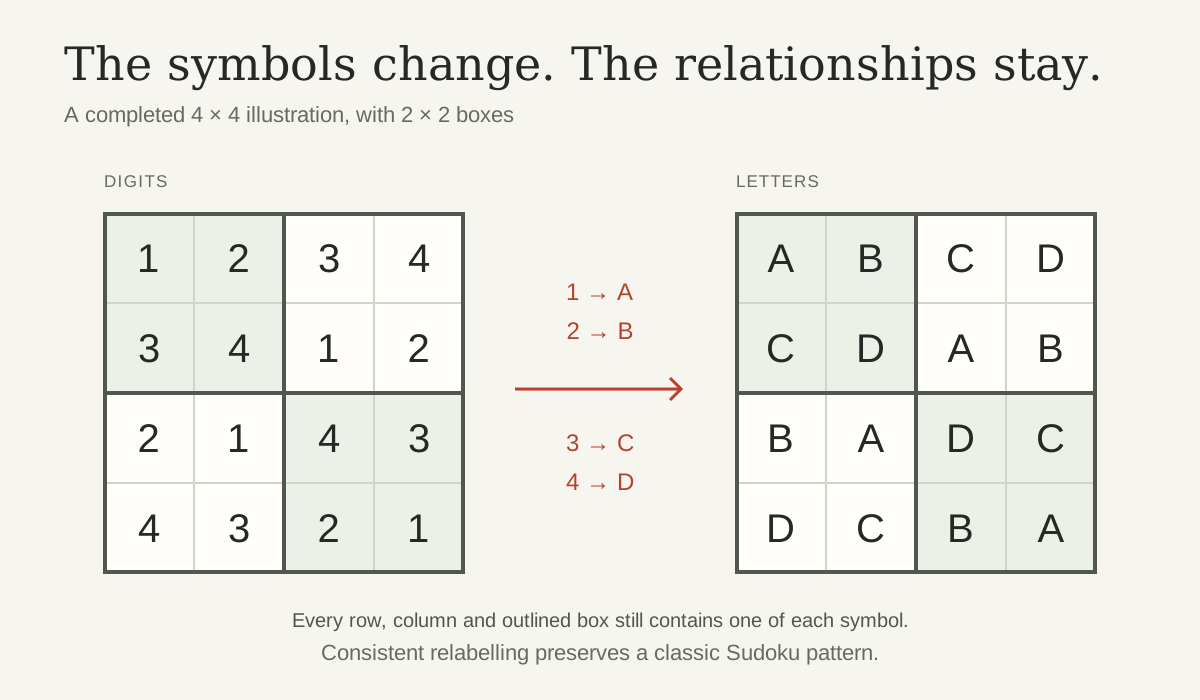
A Latin square uses a set of symbols so that every symbol appears once in each row and column. Mathematician R. A. Bailey illustrates the idea with letters, which makes the underlying rule particularly clear: the symbols need not represent quantities. [3]
A completed classic Sudoku grid satisfies that row-and-column condition and adds nine 3×3 boxes. Each box must also contain all nine digits. That extra requirement distinguishes the familiar Sudoku grid from a general Latin square. It does not make every historical Latin-square exercise an early Sudoku puzzle. [4]
Try the small example below. Replace every 1 with A, every 2 with B, and so on. The arrangement still works. You changed the labels, not which cells agree or clash. Classic Sudoku asks you to track those relationships; you do not need to add up the entries.
1979: an American magazine page
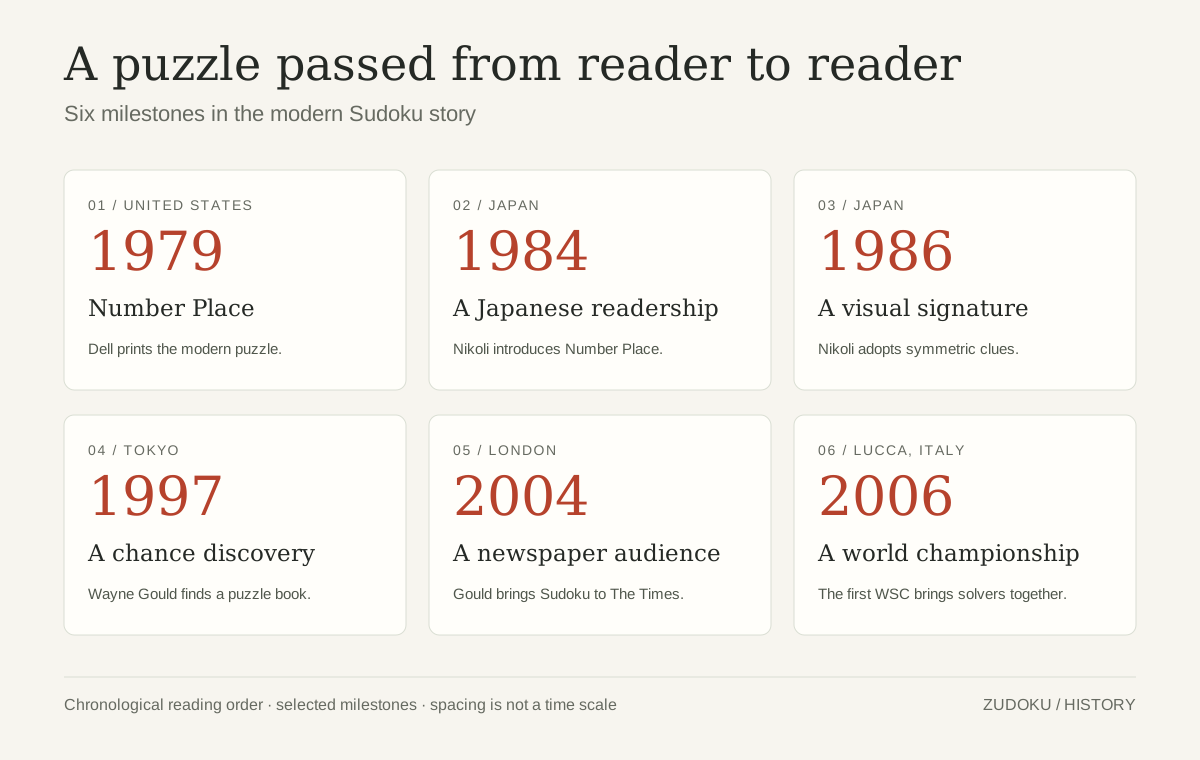
The familiar modern trail leads to Dell Pencil Puzzles & Word Games. Its May 1979 issue printed Number Place, with digits 1–9 required in every row, column and small box. Ed Pegg Jr.'s 2005 mathematics column reproduces the original page. [1]
Pegg also reports correspondence with puzzle historian Will Shortz. Comparing Dell contributor lists linked Number Place to Howard Garns, a retired architect credited with creating the puzzle. His name accompanied issues carrying Number Place and was absent from those without it. [1]
There is a useful distinction here between a publication record and a neat origin legend. The surviving magazine page gives us something concrete to examine. The attribution is a separate piece of historical detective work.
1984–1986: Japan gives it a name and a style
Nikoli’s own retrospective places its first publication of the puzzle in 1984. The date marks its introduction to the publisher’s Japanese readership. [2] A long Japanese title was shortened to Sudoku, bringing together words for number and single. [4]
Its account also identifies a design decision in 1986: arranging the starting clues symmetrically. Think of this as the visual composition of the opening grid. It concerns where clues sit, not a requirement that matching positions contain the same digit. [4]
That distinction still helps when you look at a puzzle today. An attractive pattern of clues can welcome you onto the page. The actual solving rules then take over. A lopsided arrangement does not, by itself, invalidate a Sudoku.
Do not confuse that publishing choice with the logical rules. A constructor may prefer rotational symmetry for its appearance, but a solver must still justify each placement from the given clues and constraints. Nor is a brand's account of its own design policy a measurement of every puzzle published worldwide.
1997–2004: a reader becomes a distributor
Wayne Gould encountered Sudoku during a visit to Tokyo in 1997. In a contemporary Phuket Gazette interview, he described finding a puzzle book and working out its rules by comparing an unfinished grid with a printed solution. It is an appealing example of the grid doing some of its own explaining. [5]
Gould went on to develop software that could generate puzzles. A 2006 interview in Psychology Today records six years spent on that work and his approach to The Times in London in 2004. It also records his view that Sudoku's lack of a language barrier helped it travel. [6]
This was a different contribution from creating Number Place or naming Sudoku. A newspaper needs a dependable supply of fresh puzzles. Connecting a repeatable supply with a regular publishing slot helped make the grid something readers could return to.
Look at your next grid a little differently
The next time you open a Sudoku, look at three things before you start: the arrangement of its clues, the familiar row-column-box structure, and the medium carrying it. A printed page and a phone screen offer different conveniences, but both can present the same logical relationships.
Now test the journey in three short questions. The point is to separate creation, naming, distribution and competition—not to memorise every date. If two milestones blur together, return to the timeline and ask what actually changed at each one.
Then try a classic puzzle. Each placement takes only a small mark, but the page around it carries a story of editors, constructors and readers passing an idea along.
Go to the evidence
Sources & further reading
Research checked on 14 October 2026. Follow the original sources to explore the evidence and its limits.
- Ed Pegg Jr. — Sudoku Variations
September 2005 column reproducing the May 1979 Dell page and reporting correspondence with Will Shortz about Howard Garns.
- Nikoli — Looking back at 1984
Japanese-language publisher retrospective identifying the puzzle's first appearance in Nikoli issue 12 in 1984.
- R. A. Bailey — A Latin square illustrated with letters
A mathematician's example at Queen Mary University of London explains the one-of-each-symbol row and column condition.
- Nikoli — Sudoku rules and history
The publisher's own account of its 1984 introduction, the name, and the symmetrical-clue policy adopted in 1986.
- Phuket Gazette — Boxing clever: interview with Wayne Gould
September 3–9, 2005, page 28. A contemporary interview describes Gould's 1997 Tokyo visit and discovery of a puzzle book.
- Louise Dobson — On the Job: The Puzzle Master
May 2006 interview with Wayne Gould; covers his generation software, 2004 approach to The Times, and his view on Sudoku's international appeal.
- World Puzzle Federation — Newsletter 11, October 2006
The federation's contemporary publication includes organiser Riccardo Albini's account of the first World Sudoku Championship in Lucca, Italy.
Keep exploring