The mathematics · An interactive read
Why Sudoku needs 17 clues
Why 17 is the minimum for a unique classic Sudoku solution, how researchers ruled out 16, and why fewer clues do not automatically make a puzzle harder.
The idea to take away
Seventeen is the minimum for a uniquely solvable classic 9×9 Sudoku. Clue placement and the reasoning required matter more than a sparse-looking board.
Seventeen, with one important condition
Erase most of a Sudoku grid and it starts to look impossible. Yet a classic 9×9 puzzle can leave 64 cells empty and still determine every answer. Seventeen carefully placed clues can be enough. Sixteen cannot give exactly one solution.
The condition is exactly one. Seventeen is a minimum achieved by some puzzles, not a guarantee attached to any seventeen numbers. Finding the fewest clues for a particular completed grid is a separate problem. Nor does this result automatically transfer to Killer, diagonal Sudoku, or other rulesets. [5]
Two similar words are worth separating. A minimum puzzle attains the smallest possible clue count. A minimal puzzle merely loses uniqueness if any one of its clues is removed; it can have more than 17 clues. A puzzle being minimal does not tell you that nobody could construct a sparser puzzle. [1]
The job of a clue is to rule things out
A completed grid is an ending. A clue says that every acceptable ending must contain this particular digit in this particular cell. Several clues work together to exclude alternatives. A puzzle is unique only when one complete grid survives.
Here is an original, smaller example using digits 1–4 and 2×2 boxes. The twelve visible clues fit both completed boards. Check the highlighted cells: the 1s and 2s trade places, while every row, column, and box still obeys the rules. The original puzzle therefore has two solutions.
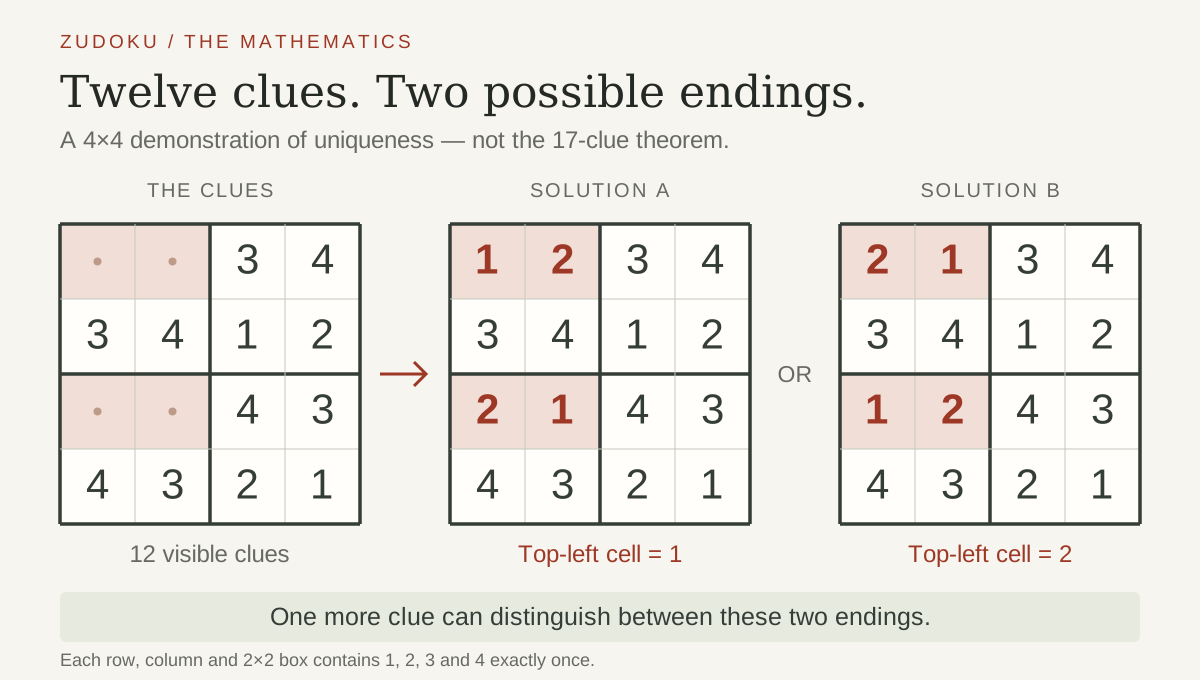
No amount of staring can turn those twelve clues into a unique answer. The missing information has to come from another clue or an additional rule. That is different from a unique puzzle whose next deduction is simply difficult to spot.
There are more endings than you can picture
Bertram Felgenhauer and Frazer Jarvis calculated that classic Sudoku has 6,670,903,752,021,072,936,960 completed grids. Their 2005 account combines reductions of the search space with computer enumeration. This counts complete, valid arrangements of the digits, not starting puzzles. [2]
That distinction matters. Take one completed board and cover different selections of cells: you have produced different starting positions sharing an answer. Some positions still identify that answer uniquely; others leave several possibilities. Counting endings and counting good puzzles are different tasks.
The enormous total also explains why testing a few thousand sparse puzzles could never settle the minimum. Failing to find something is persuasive only when you can show that your search covered every relevant possibility.
Different digits, the same structure
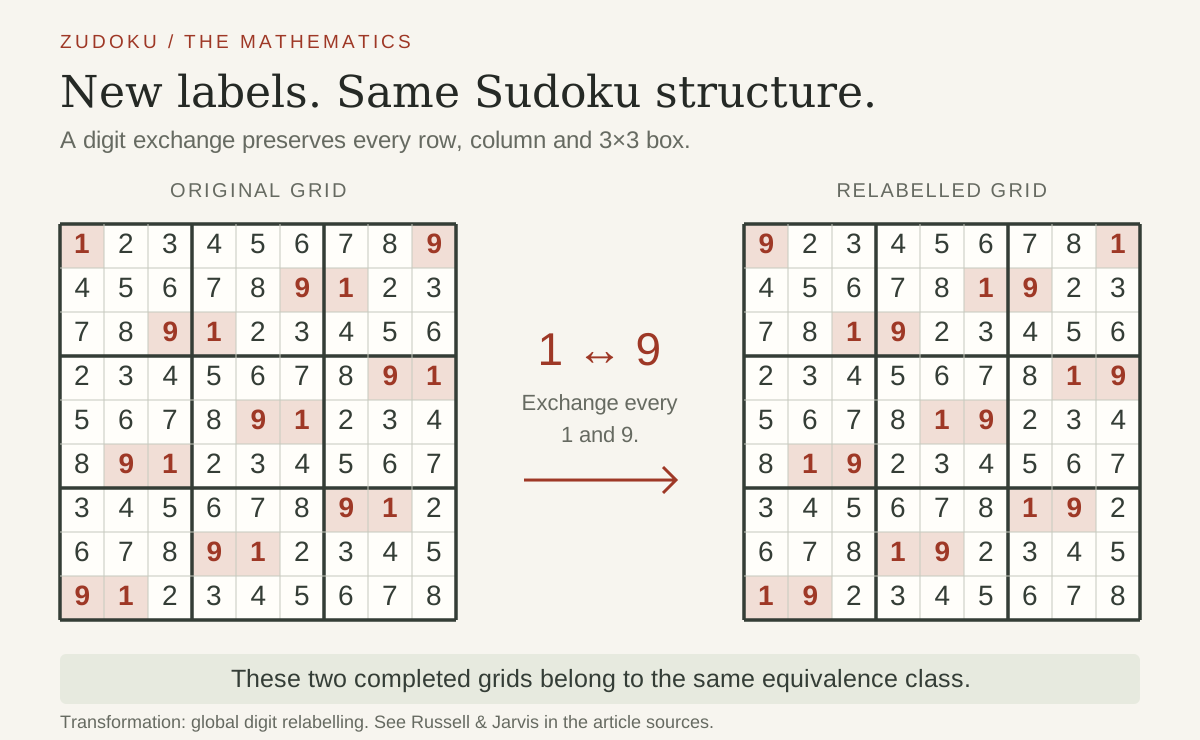
Swap every 1 with a 9 and every 9 with a 1. A valid completed grid stays valid. Rotate it, or exchange two rows within the same three-row band, and the rules still hold. An arbitrary exchange of rows from different bands does not have that guarantee.
Ed Russell and Frazer Jarvis grouped completed grids using the standard transformations that preserve Sudoku, including digit relabelling, rotations, reflections, and permitted row and column rearrangements. They obtained 5,472,730,538 essentially different grids. This counts equivalence classes, not puzzles, and uniqueness of a puzzle is a different concept. [3]
How researchers ruled out sixteen
In 2012, Gary McGuire, Bastian Tugemann, and Gilles Civario announced an exhaustive computer-assisted proof that no 16-clue classic Sudoku has a unique solution. [1]
An unavoidable set comprises cells that can change to another valid completion while the rest stay fixed. A unique puzzle needs a clue in every such set. Efficient hitting-set enumeration, followed by candidate uniqueness checks, made the exhaustive search feasible. [1]
The smaller counts follow too: adding correct clues to a unique puzzle cannot introduce a second solution. A hypothetical unique 15-clue puzzle would therefore yield a unique 16-clue puzzle.
Try it on a tiny board
The lab below uses a 4×4 toy Sudoku with 2×2 boxes. It demonstrates how clues constrain solutions; it does not prove, or simulate the proof of, the 17-clue theorem for a 9×9 board.
Remove a clue and watch the solution count. It may stay at one: the remaining clues can already force the erased value. Remove another and an alternative may appear. The interesting question is which clue makes the difference, rather than how many empty squares you can create.
There is a useful check on your intuition. Erasing a clue only relaxes a condition, so every previous solution remains possible. The number of solutions can stay the same or increase; it cannot decrease. Restoring a correct clue reverses that filtering process.
Try predicting the result before each change. Then inspect the surviving boards. This turns an abstract word, uniqueness, into something you can test cell by cell.
Sparse does not automatically mean hard
A clue count is easy to display. Human difficulty is harder to measure. In a study comparing ratings with human solving data, Radek Pelánek found that models reflecting solving steps and their dependencies predicted difficulty much better than the number of givens alone. The analysis distinguishes the complexity of individual deductions from the way one deduction unlocks another. [4]
Think of two paths through a puzzle. One offers several obvious next moves. Another makes you find one specific deduction before anything opens up. Counting the printed digits tells you little about that experience.
This is why a minimum-clue record should not become your training target. Choose puzzles whose explanations teach you something. When you get stuck, ask what relationship you missed: a row, a box, a candidate pair, or a chain of consequences.
A better question for your next puzzle
Instead of asking whether a board looks empty enough to be impressive, ask two questions: does it have one solution, and can I explain my next move? The first is a property of the puzzle. The second is a useful measure of your progress.
If you are checking a puzzle you copied from somewhere else, enter its original clues in the Sudoku Solver and choose Analyze to check whether it has one solution. Keep a copy before revealing an answer. Then return to the board and try one deduction yourself. Seventeen is a remarkable mathematical boundary; understanding why a particular cell must be a 7 is where the playing happens.
Go to the evidence
Sources & further reading
Research checked on 14 October 2026. Follow the original sources to explore the evidence and its limits.
- McGuire, Tugemann & Civario — There is no 16-Clue Sudoku
First posted January 1, 2012; revised 2013. Exhaustive proof and hitting-set method, especially sections 1 and 4.
- Felgenhauer & Jarvis — Enumerating possible Sudoku grids
June 20, 2005. The result section gives the exact completed-grid count; these are not starting puzzles.
- Russell & Jarvis — Sudoku enumeration: the symmetry group
Authors' calculation of 5,472,730,538 equivalence classes and the precise permitted transformations.
- Pelánek — Difficulty Rating of Sudoku Puzzles: An Overview and Evaluation
2014. Sections 4–5 and Table 3 compare clue count, logical-step models and human solving results.
- Tjusila, Besançon, Turner & Koch — How Many Clues To Give?
2023. Introduction distinguishes the global 17-clue minimum from finding a minimum for a specified solution grid.
Keep exploring